

Equestrian arena flood risk is the likelihood that a riding arena will be damaged, made unsafe, or rendered unusable by flooding, whether from surface water pooling, sub-base saturation, or direct inundation from nearby watercourses. It is not simply about whether water enters the arena during heavy rain. The real concern is whether your construction, drainage, and site planning can limit that water’s impact on footing integrity, horse and rider safety, and long-term maintenance costs. For anyone building or managing an arena in the UK, where prolonged rainfall is a consistent seasonal reality, understanding flood risk before you break ground is far more cost-effective than managing the consequences afterwards.
The key factors that drive flood risk in equestrian arenas include:
- Site location: proximity to rivers, streams, low-lying ground, or areas with a history of surface water flooding
- Soil type: clay-heavy soils drain poorly and retain water, accelerating surface pooling and sub-base saturation
- Surface grading: insufficient slope prevents water from leaving the arena naturally
- Drainage infrastructure: absent or undersized perimeter and sub-surface drainage systems cannot cope with high-intensity rainfall
- Base construction: inadequate sub-base depth or missing geotextile layers allow water to migrate upward and destabilise the footing
- Proximity to impermeable surfaces: hardstanding, roofs, and compacted tracks can channel large volumes of water directly towards an arena
The impact of flooding on a riding arena extends well beyond a few days of cancelled sessions. Waterlogged footing breaks down structurally, creating uneven and unpredictable surfaces that increase the risk of injury to horses and riders. Sub-base failure, once it begins, is expensive to reverse. Understanding flood risk at the planning and construction stage is the point at which you have the most control and the lowest cost of action.
How to build an equestrian arena on flood-prone ground
Site selection is your first and most powerful tool. Positioning an arena on the highest available ground within a paddock or field, even a modest elevation above the surrounding land, can meaningfully reduce the volume of water that reaches the arena during a storm. Where the site offers no natural elevation advantage, cut and fill construction raises the arena footprint above the surrounding ground level, providing a physical buffer against inundation.
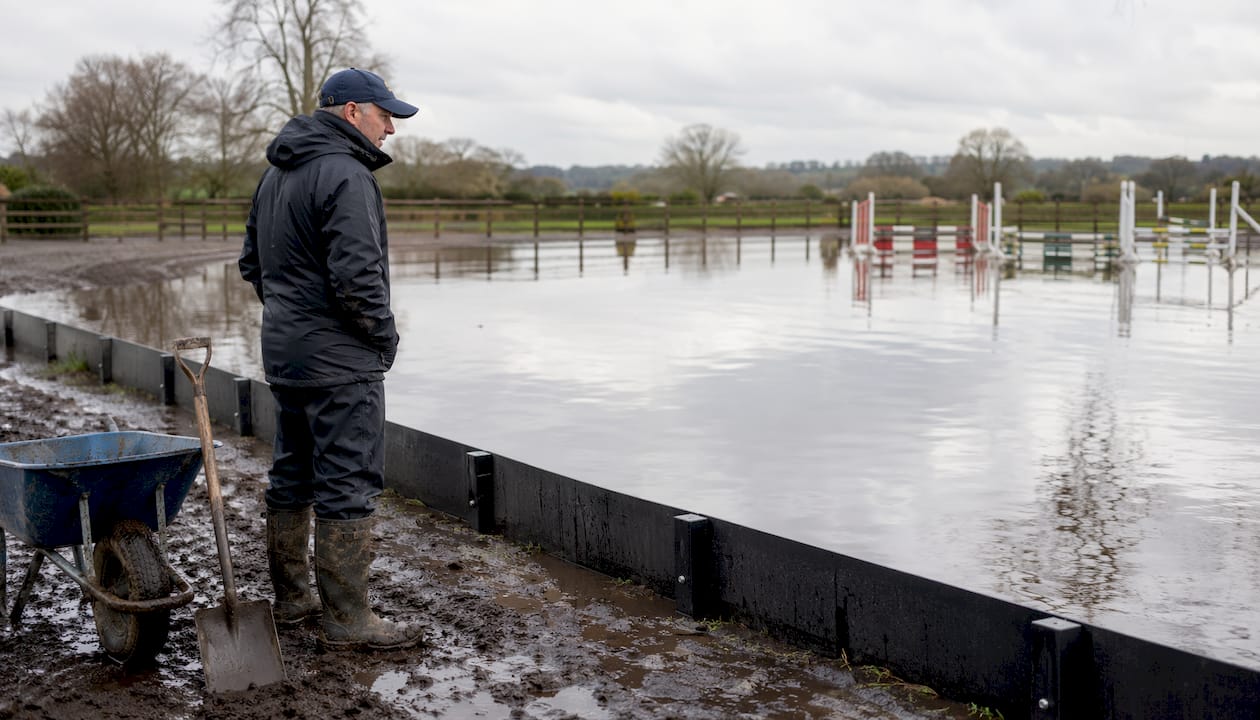
Raising the arena footprint by 400mm or more using compacted crushed stone is a well-established method for flood-prone sites. The compacted fill acts as both a structural base and a drainage buffer, allowing water to pass through rather than accumulate beneath the surface. Flood prevention banks, constructed from compacted material around the arena perimeter, add a further layer of protection by diverting surface water away before it reaches the riding area.
Surface grading is non-negotiable. A surface slope of 1–2% ensures water moves efficiently towards drainage points without creating uneven footing. Slopes flatter than 1% allow water to pool, while steeper than 2% produce a noticeably uneven and uncomfortable surface for horses.
Key construction considerations for flood-prone sites:
- Geotextile separation layers: a woven or non-woven arena membrane between the sub-base and the riding surface prevents fine particles from migrating upward and contaminating the base
- Compacted sub-base depth: a deeper, well-compacted crushed stone base resists saturation and maintains structural integrity after flood events
- Perimeter drainage channels: installed at the arena edge to intercept and remove surface water before it enters the riding area
- Access tracks: designed to drain away from the arena so that post-flood access for machinery and repair is not blocked by standing water
- Surface material selection: heavier, well-draining materials such as angular silica sand resist floating and displacement during inundation better than lightweight organic alternatives
Pro Tip: Skipping the geotextile separation layer is one of the most common and costly construction errors on flood-prone sites. Once sub-base contamination begins, the only remedy is to excavate and rebuild from the base up. Fitting the membrane correctly at the outset costs a fraction of that repair.
What drainage systems actually prevent arena flooding?
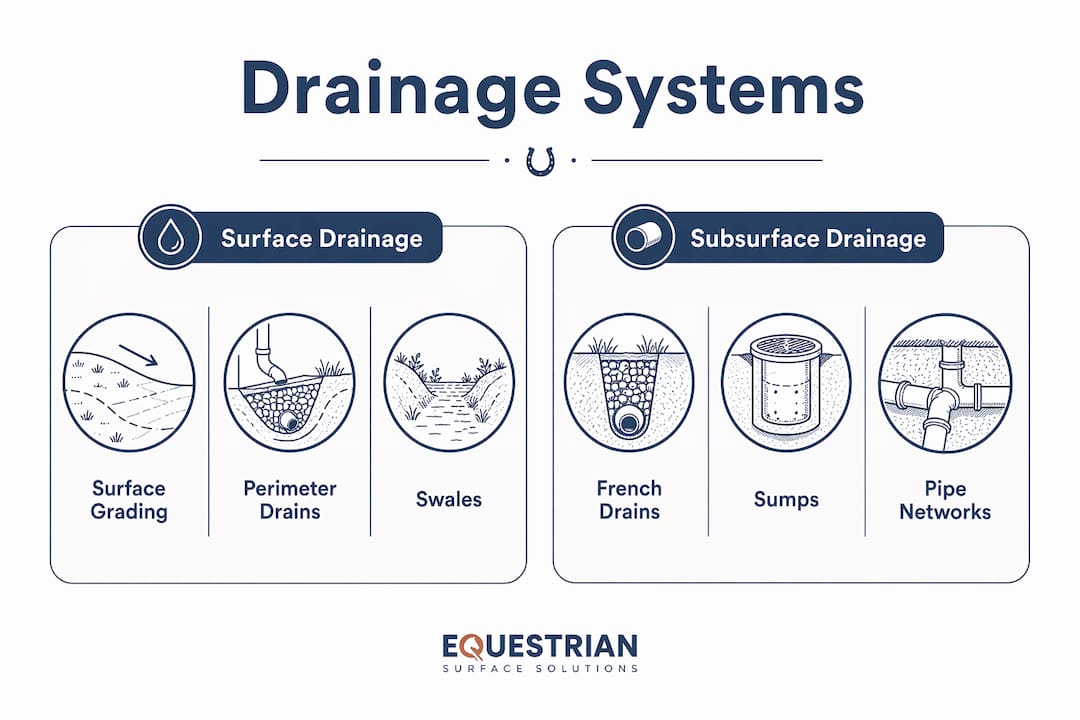
Good drainage is the difference between an arena that recovers within 24 hours of heavy rain and one that remains unusable for weeks. A well-designed system works at three levels: surface, perimeter, and sub-surface.
| Drainage type | Function | Key design consideration |
|---|---|---|
| Surface grading | Directs water off the riding surface towards collection points | Maintain a 1–2% slope across the full arena width |
| Perimeter channel drains | Intercept runoff at the arena edge before it pools | Size channels to handle peak storm flow, not average rainfall |
| Sub-surface pipe systems | Remove water that penetrates the surface and base layers | Perforated pipes bedded in clean stone, connected to outfall |
| Dry wells / soakaways | Absorb and disperse collected water into surrounding ground | Only viable where soil permeability is sufficient |
| Roof gutter outflows | Manage rainwater from indoor arena roofing independently | Must discharge to a separate system, not the arena perimeter drain |
Arena drainage design should target what engineers call a design storm: typically a 25-year, 24-hour storm event for most UK locations, rising to a 50-year event for sites in recognised flash flood zones or areas with a history of rapid surface water accumulation. Designing to the average rainfall year is a false economy on a flood-prone site.
One failure point that catches many arena owners off guard is indoor arena roof drainage. Gutter outflows from a large indoor roof can generate a very high volume of water in a short period. Routing that flow into the same corner drain as the arena perimeter system overwhelms the drainage capacity and causes the very pooling the system was designed to prevent. Roof drainage and arena perimeter drainage must be treated as independent systems with separate outfalls.
Poor drainage leads directly to footing breakdown, unsafe riding conditions, and significant replacement costs every few years for footing alone, in addition to the labour overhead of managing a waterlogged surface. For professional guidance on agricultural pipe systems that can be adapted for arena drainage, specialist suppliers offer detailed specification support.
Flood risk assessment and UK planning requirements
The Environment Agency divides England into flood zones that classify the probability of river and sea flooding. Flood Zone 3 carries the highest risk designation and requires detailed flood risk documentation for any new development, including equestrian arenas. Flood Zone 2 represents a medium probability, and Flood Zone 1 the lowest, though surface water flood risk can affect sites in any zone.
Before submitting a planning application for a new arena, you should:
- Check the Environment Agency’s flood map: the long-term flood risk checker gives a free initial assessment for any address in England
- Commission a flood risk assessment (FRA): required for developments in Flood Zones 2 and 3, and for sites over one hectare in Flood Zone 1; the FRA must demonstrate that the development will not increase flood risk to neighbouring land
- Apply the sequential test: planning authorities require applicants to show that no lower-risk alternative site is available before approving development in a higher flood zone
- Prepare a drainage strategy: local planning authorities increasingly require a sustainable drainage system (SuDS) strategy as part of the application, particularly for sites with significant impermeable surface area
- Register for flood warnings: the Environment Agency’s flood warning service provides advance notice that allows you to take protective action before water arrives
Insurance is a parallel consideration. Facilities with documented flood risk assessments and professionally designed drainage systems often attract lower premiums than those without, reflecting demonstrated risk reduction. Insurers assess both the physical risk and the quality of the mitigation measures in place, so documentation matters as much as the construction itself.
Climate change projections from the Environment Agency indicate that extreme rainfall events in the UK are becoming more frequent and more intense. Planning an arena today to the drainage standards of a decade ago may leave it underspecified within its operational lifetime. Building in additional drainage capacity at the construction stage costs far less than retrofitting it later.
What happens after a flood, and how arenas recover
Flood events affecting equestrian arenas follow a broadly consistent pattern. Surface water enters the arena, saturates the footing, and in severe cases penetrates the sub-base. The footing material, whether sand, fibre, or rubber, may float, migrate, or compact unevenly as the water recedes. The riding surface that remains is rarely safe to use without assessment and remediation.
Practical recovery steps after a flood event:
- Do not ride until the surface has been assessed: waterlogged footing is structurally unpredictable and the risk of injury to horses is high
- Allow the surface to drain fully before working it: dragging or harrowing wet footing compacts it and accelerates breakdown
- Inspect the sub-base: lift sections of footing to check whether the base layer has shifted, softened, or been contaminated by fines migrating upward
- Replace displaced footing material: material that has floated to the arena perimeter or been washed out entirely will need topping up; arena surface problems caused by flood events often require partial or full footing replacement
- Check and clear drainage channels: debris carried by floodwater frequently blocks perimeter drains and sub-surface pipe inlets, reducing capacity for the next rainfall event
- Document the damage: photographs and written records support insurance claims and inform future mitigation decisions
Long-term monitoring after a flood should include regular checks of sub-base integrity, drainage outfall performance, and footing depth. Arenas that have flooded once are statistically more likely to flood again if the underlying drainage or site conditions have not been addressed. Flood risk is cumulative: sub-base degradation and footing breakdown after repeated events threaten long-term safety more than any single surface water incident.
Preparedness measures that reduce recovery time include keeping spare footing material on site, maintaining a clear record of drainage system layouts, and establishing a relationship with a contractor who can mobilise quickly for post-flood repairs.
UK engineering standards and expert guidance on flood resilience
UK arena construction best practice draws on civil engineering drainage standards that specify both the design storm return period and the minimum slope grades required for effective water management. The accepted standard for outdoor arenas is a surface grade of 1–2%, which should run consistently from the centre of the arena towards perimeter channels rather than pooling in low spots created by uneven compaction.
The sub-base specification matters as much as the surface. A well-graded crushed stone base, typically 150mm or deeper on flood-prone sites, provides both structural support and drainage capacity. The geotextile separation layer between the sub-base and the riding surface is not optional on sites with any flood exposure. Without it, fine particles from the footing migrate into the stone base over time, reducing its drainage capacity and eventually causing the kind of surface failures that require full reconstruction.
Flood risk is cumulative. Sub-base failure and footing integrity degradation threaten long-term arena safety more than surface water alone. Addressing drainage at the construction stage is the most cost-effective point of intervention.
Cut and fill construction, combined with flood prevention banks around the arena perimeter, is the standard approach for sites in seasonally wet or periodically inundated areas. The raised footprint provides a buffer; the banks divert surface water before it reaches the riding area. Both measures work best when the drainage system is designed to handle the volume of water that the raised footprint and banks will intercept and redirect.
Pro Tip: Design your indoor arena roof drainage as a completely independent system from the arena perimeter drains. Routing both into the same outfall point is a non-obvious failure that overwhelms drainage capacity during the storms that matter most.
Equestrian Surface Solutions works with arena owners across the UK to specify materials that perform well on sites with drainage challenges, from woven and non-woven membranes that protect sub-base integrity to footing blends chosen for their drainage characteristics and resistance to displacement during wet conditions.
How Equestrian Surface Solutions can help you build with confidence
Flood risk does not have to mean a compromised arena. With the right materials, the right base specification, and a drainage design matched to your site’s actual risk profile, you can build an arena that performs reliably through the UK’s wettest seasons. Equestrian Surface Solutions supplies the full range of materials needed for flood-resilient arena construction, from specialist arena surfaces and silica sands to drainage membranes and sub-base products.
Whether you are planning a new build on a flood-prone site or refurbishing an existing arena that has suffered water damage, the team at Equestrian Surface Solutions can advise on the right specification for your conditions, discipline, and budget. Get in touch for a free surface quote and expert guidance tailored to your site.
Key takeaways
Equestrian arena flood risk requires addressing drainage, base construction, and site planning together, because surface water alone rarely tells the full story of what damages an arena.
| Point | Details |
|---|---|
| Surface grade is critical | A 1–2% surface grade ensures water drains efficiently while providing a level and safe riding surface. |
| Sub-base integrity matters most | Geotextile layers and compacted stone bases prevent the sub-base failure that drives long-term costs. |
| Drainage costs less upfront | Footing replacement costs every few years on poorly drained arenas. |
| UK planning requires documentation | Flood Zones 2 and 3 require a formal flood risk assessment before planning permission is granted. |
| Insurance rewards good drainage | Well-drained facilities often attract lower liability insurance premiums than those without. |
FAQ
What is equestrian arena flood risk in the UK?
Equestrian arena flood risk is the probability that a riding arena will be damaged or made unusable by flooding, whether from surface water, sub-base saturation, or proximity to watercourses. In the UK, the Environment Agency’s flood zone classifications provide the official framework for assessing this risk at any given site.
What is the best surface for a horse arena on a flood-prone site?
Angular, washed silica sand is the most widely used base footing material for flood-prone arenas because it drains freely and resists compaction. Fibre and rubber additives can improve performance further, but the sub-base specification and drainage design beneath the surface have a greater influence on flood resilience than the footing material alone.
How deep should horse arena footing be?
Most outdoor arenas perform well with a riding surface material over a properly compacted and graded sub-base. On flood-prone sites, the sub-base should be at least 150mm of clean crushed stone to provide adequate drainage capacity and structural support after saturation events.
Can you use river sand for a horse arena?
River sand is generally unsuitable for equestrian arenas because its rounded particle shape provides poor stability and it tends to compact and shift under load. Angular, washed silica sand with a consistent particle size is the preferred choice, offering better drainage, less compaction, and greater footing consistency for horses.
How do you manage flooding in an existing equestrian arena?
The most effective approach is to install or upgrade perimeter channel drains, verify and restore the 1–2% surface grade, and check that sub-surface pipe systems are clear and connected to a functioning outfall. Where sub-base contamination has already occurred, partial or full reconstruction of the base layer is usually necessary before surface drainage improvements will have lasting effect.
