
Drainage is the single most important structural element in any horse arena. The role of drainage in horse arenas is to move water efficiently away from the riding surface, protecting footing integrity and preventing the base layers from becoming unstable. Poor drainage is the leading cause of arena failure, and no amount of premium footing material will compensate for a system that cannot handle rainfall. Getting drainage right from the start determines whether your arena lasts five years or twenty-five.
How are drainage systems designed and built in horse arenas?
A well-engineered arena drainage system works in layers, each with a specific job. The sub-base is compacted and graded first, then a geotextile separation fabric is laid to stop fine soil particles migrating upward into the stone layers above. This fabric is not optional. Without it, soil contamination destroys the drainage capacity of the base within a few seasons.
Perforated drainage pipes sit at the heart of the system. Perimeter drainage uses 100mm perforated pipes in moderate rainfall zones such as the UK, with 150mm pipe required in higher rainfall areas. Each pipe must be wrapped in a geotextile sock to prevent silt from entering and blocking the perforations. Pipes are bedded in washed stone, run in continuous lengths, and laid with a consistent fall.
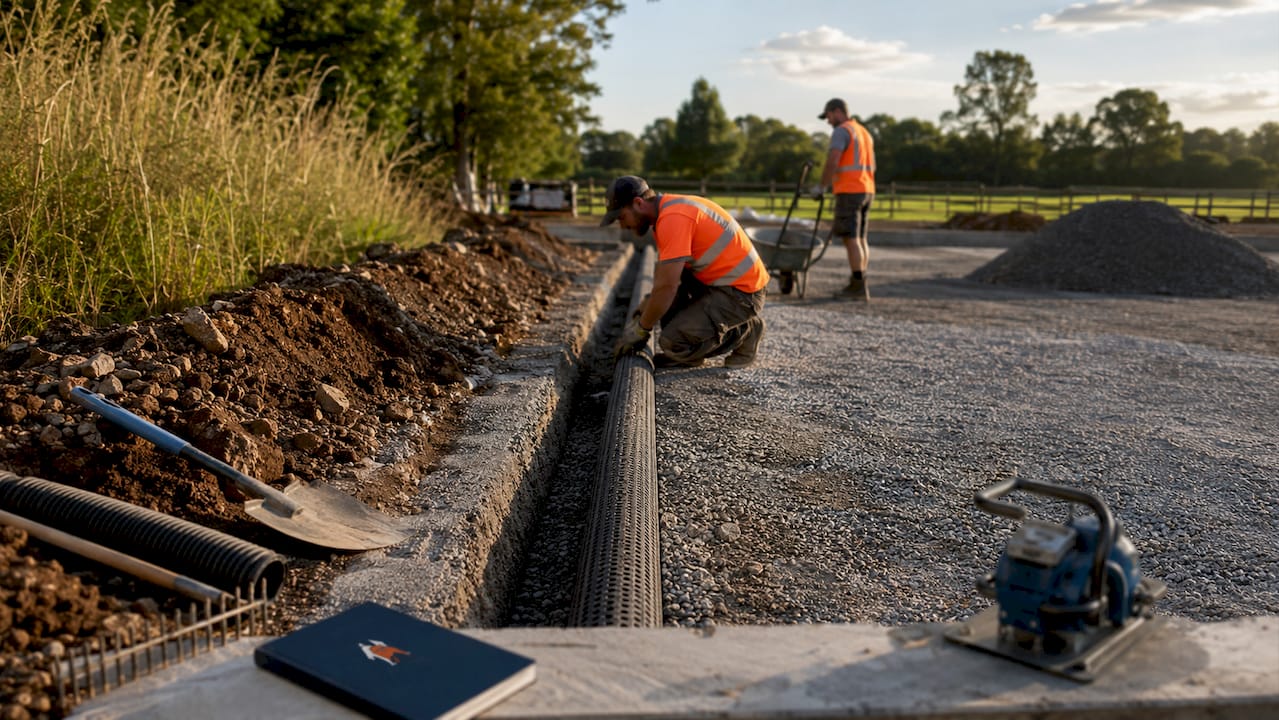
Pipe slope is a critical specification that is frequently overlooked. Industry standards target a pipe slope of ideally 1%, with a minimum of 0.5% to maintain adequate flow. Below that threshold, water sits in the pipe rather than draining away, and the system fails under sustained rainfall.
The arena surface itself also sheds water through a designed crown slope. Outdoor arenas require a 1.5% to 2% crown slope, while indoor arenas need 1% to 1.5%. That gradient directs surface water toward the perimeter drains before it can pool on the riding area.
- Geotextile separation fabric beneath the stone base
- 100mm or 150mm perforated pipe with geotextile sock wrapping
- Washed stone bedding around all drainage pipes
- Pipe slope of 1% (minimum 0.5%)
- Crown slope of 1.5%–2% for outdoor arenas
Pro Tip: Ask your contractor to confirm pipe diameter, slope, and geotextile sock specification in writing before any groundworks begin. Vague proposals without these details are a reliable warning sign of future problems.
Why do climate and site conditions change drainage requirements?
Site drainage considerations begin before a single machine arrives on site. The location of your arena determines how much water the system must handle, what soil types it sits on, and whether frost damage is a risk. Choosing a low-lying site with poor natural drainage multiplies the engineering challenge and the cost.
Rainfall intensity is the primary variable that dictates pipe sizing. Industry drainage design targets a 25-year, 24-hour storm event, which means the system must handle the worst realistic rainfall your region experiences. That standard exists because undersized drainage fails precisely when you need it most.
- Assess annual rainfall and peak storm intensity for your specific location before specifying pipe diameter.
- Identify soil type. Clay soils drain slowly and require more aggressive pipe networks than free-draining sandy soils.
- Check the frost line depth. Pipes must be installed below the frost line in cold climates to prevent cracking from frozen water expansion.
- Evaluate natural site drainage. A site that already sheds water well reduces the load on your engineered system.
- Account for roof drainage if building an indoor arena. Roof runoff directed onto an arena site without separate management overwhelms perimeter drains.
Neglecting climate-specific drainage design is the most common reason arenas fail within four years of construction. A system built for average rainfall in a high-intensity zone will be overwhelmed the first time a serious storm arrives, and the repair bill will dwarf the original saving on pipe diameter.
Soil contamination and siltation are the slow failures that climate neglect accelerates. In areas with heavy clay soils and high rainfall, fine particles migrate into drainage layers and pipes unless every specification is correct. The result is a system that appears to work for the first year or two, then fails progressively as blockages build.
What impact does effective drainage have on arena performance?
Consistent footing is the direct product of consistent moisture management. Water trapped beneath footing destroys footing structure and creates the boggy, slick, or hard patches that compromise horse safety. A well-drained arena maintains uniform moisture across the entire surface, which is what produces reliable traction and shock absorption.
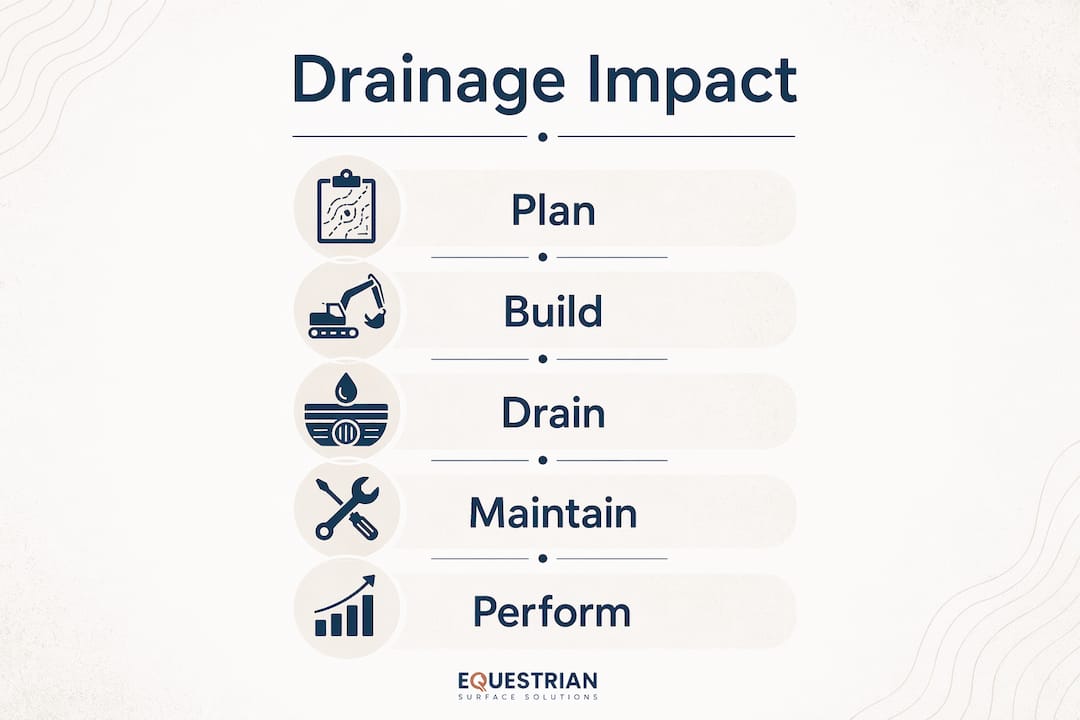
The financial case for quality drainage is straightforward. A well-built arena base with proper drainage can last over 25 years. Arenas with vague or under-specified drainage typically require costly full repairs by year four. The base is the most expensive element to rebuild, and it is the element that drainage protects.
| Drainage outcome | Effect on arena |
|---|---|
| Consistent moisture management | Uniform footing traction and shock absorption across the surface |
| Prevention of sub-base saturation | Base layer retains structural integrity and compaction over decades |
| Controlled surface water shedding | No pooling, no ice formation in winter, no boggy patches after rain |
| Reduced footing degradation | Fibre, rubber, and sand surfaces last significantly longer between top-ups |
Maintenance frequency drops sharply when drainage works correctly. High-quality footing materials fail if underlying drainage is not correctly engineered, which means even premium surfaces need constant attention when the base is wet. Correct drainage removes that burden. You can find more detail on how drainage affects ongoing upkeep in this arena maintenance guide.
Pro Tip: After heavy rainfall, walk the full perimeter of your arena and check that water is exiting the outfall points. If it is not, investigate pipe blockage or slope failure before the next wet season.
Common mistakes in arena drainage installation to avoid
Most drainage failures are predictable. They follow the same patterns, and nearly all of them stem from decisions made during the design or specification stage rather than from poor workmanship on site.
- Skipping geotextile socks. Without a geotextile sock around perforated pipes, silt blocks the system within 18 months, requiring full re-excavation. This is the single most common and most avoidable drainage failure.
- Under-specifying pipe diameter. Contractors frequently under-specify pipe diameter for local rainfall intensity, particularly in wetter regions. The cost difference between 100mm and 150mm pipe is under 15% at wholesale. Re-excavation costs can reach 400% of the original build cost.
- Incorrect pipe depth in cold climates. Pipes installed above the frost line crack when water inside them freezes and expands. This failure is invisible until the system stops working entirely.
- Poor base compaction. A sub-base that is not properly compacted settles unevenly, disrupting pipe alignment and slope. Once the footing is laid, correcting this requires a full rebuild.
- Neglecting separation fabric. Without geotextile fabric between the sub-base and stone layers, fine soil migrates upward and fills the drainage voids. The surface failures this causes are expensive to diagnose and repair.
- Misaligned crown slope. A crown that drains toward the centre rather than the perimeter turns the arena into a collection basin. This is a design error, not a construction one, and it is entirely preventable.
My honest view on drainage as the foundation of arena success
After working with equestrian professionals across the UK, I have seen the same mistake repeated more than any other. Owners invest heavily in premium footing, quality sand, and fibre blends, then accept a drainage specification that is vague, undersized, or simply missing key details. The footing looks excellent for the first season. By year three, the base is saturated, the surface is uneven, and the repair cost exceeds what a correct drainage system would have cost in the first place.
Drainage is not glamorous. You cannot see it once the arena is built. That invisibility is exactly why it gets undervalued. My view is that drainage deserves the largest share of your specification scrutiny, not the smallest. Every pound spent on correct pipe sizing, proper geotextile socks, and accurate crown grading returns many times over in reduced maintenance and extended surface life.
The other thing I would say is that drainage is not one-size-fits-all. A system that works perfectly in the south of England may be wholly inadequate in the Scottish Highlands or in a frost-prone yard. Tailoring your drainage specification to your actual climate and soil conditions is not an optional refinement. It is the difference between an arena that performs for twenty-five years and one that needs rebuilding in four.
— Stacey
How Equestrian Surface Solutions can support your arena drainage project
Getting drainage right requires the correct materials specified for your climate, soil, and arena size. Equestrian Surface Solutions supplies the full range of materials needed for a properly engineered drainage system, from woven and non-woven geotextile membranes to base aggregates and surface footing products suited to every discipline.
Whether you are planning a new build or refurbishing an existing arena, the team at Equestrian Surface Solutions provides expert guidance on drainage specification, material selection, and surface performance. Our arena surfaces and self-build kits are designed to work with correctly engineered drainage systems, giving you a surface that performs consistently through every season. Contact us to discuss your project and receive a tailored material recommendation based on your site conditions and riding goals.
FAQ
What is the role of drainage in horse arenas?
Drainage manages water movement beneath and around the arena surface, preventing pooling, base saturation, and footing degradation. Without it, even premium footing materials fail within a few years.
What pipe size is needed for arena drainage in the UK?
100mm perforated pipe is standard for moderate UK rainfall zones, but 150mm pipe is required in higher rainfall areas. All pipes must be wrapped in a geotextile sock to prevent silt blockage.
What slope should arena drainage pipes be installed at?
The ideal pipe slope is 1%, with a minimum of 0.5% to maintain adequate water flow. Below 0.5%, water stagnates in the pipe and the drainage system fails under sustained rainfall.
How does poor drainage affect horse safety?
Poor drainage creates uneven footing moisture, producing boggy, slick, or hard patches that increase the risk of slipping and injury. Consistent drainage is a direct requirement for a safe riding surface.
How long does a well-drained arena base last?
A correctly engineered arena base with proper drainage can last over 25 years. Arenas with under-specified or missing drainage typically require costly full repairs by year four.
Key takeaways
Proper drainage is the structural foundation of every successful horse arena, and no footing material compensates for a system that cannot manage rainfall effectively.
| Point | Details |
|---|---|
| Drainage determines arena lifespan | A correctly engineered system protects the base for over 25 years; poor drainage causes failure by year four. |
| Pipe specification must match climate | Use 100mm pipe for moderate UK rainfall and 150mm in high-intensity zones; always wrap in a geotextile sock. |
| Crown slope sheds surface water | Outdoor arenas need a 1.5%–2% crown slope to direct water to perimeter drains before it pools. |
| Geotextile fabric prevents contamination | Separation fabric between sub-base and stone stops fine soil migrating upward and destroying drainage capacity. |
| Climate-specific design is non-negotiable | Frost line depth, soil type, and peak storm intensity must all inform pipe sizing, depth, and layout. |
