
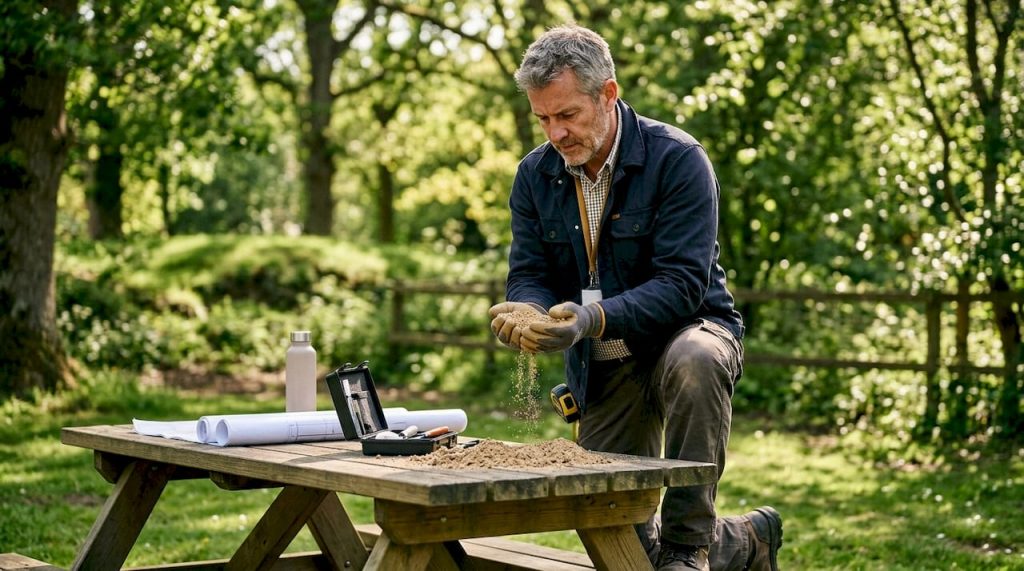
A spec surface for a competition arena is the engineered combination of graded silica sand, fibre or rubber additives, and a compacted sub-base designed to deliver consistent grip, shock absorption, and drainage under competition conditions. Getting the specification right is not a preference. It is a safety requirement. A horse weighing 500–650kg landing from a 1.2m fence places extreme load on the surface in a fraction of a second, and the footing must absorb and redistribute that force without slipping or compacting. This guide covers arena surface specifications from sand grading through to sub-base construction, giving equestrian professionals and competitive riders the technical detail needed to commission or assess a competition-grade surface with confidence.
What are the essential sand specifications for a spec surface for competition arena?
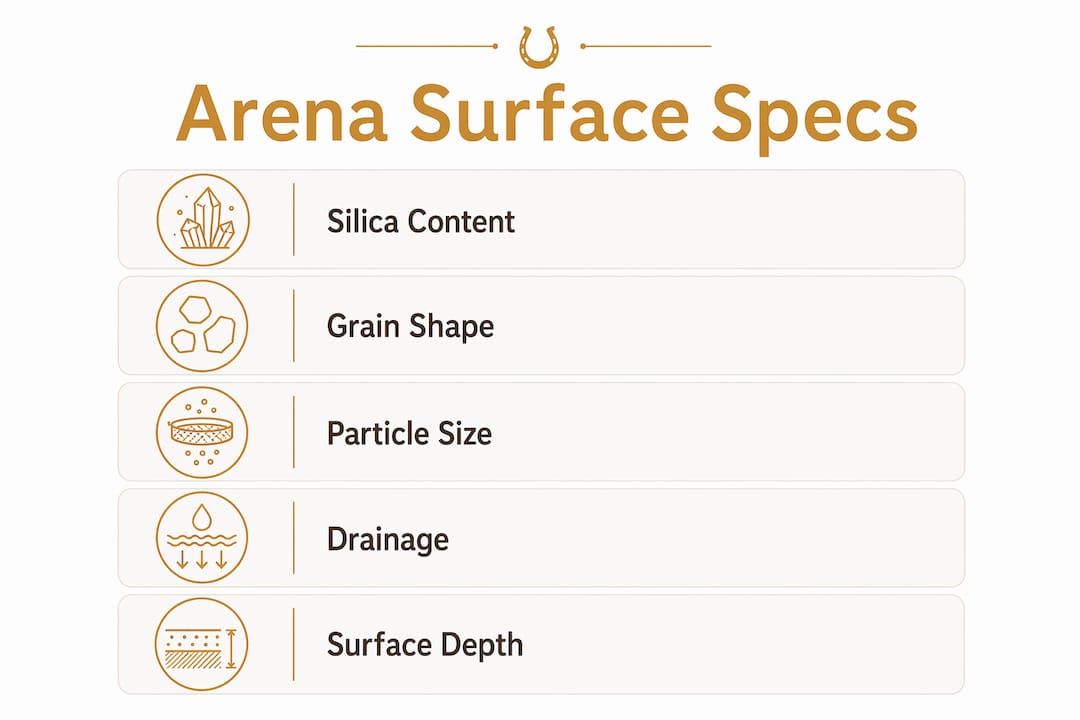
Professional-grade arena sand requires a minimum 95% silica (SiO₂) content for competition-grade performance. That figure is not arbitrary. High silica content resists breakdown under repeated loading, which means the surface stays consistent across a full competition day rather than degrading between classes.
Grain shape matters as much as mineral content. Sub-angular grains interlock under load to create a stable surface, then release when the hoof lifts. Rounded grains behave like ball bearings and shift unpredictably. Angular grains lock too tightly and create a hard, unforgiving surface. Sub-angular is the target for every competition arena surface.
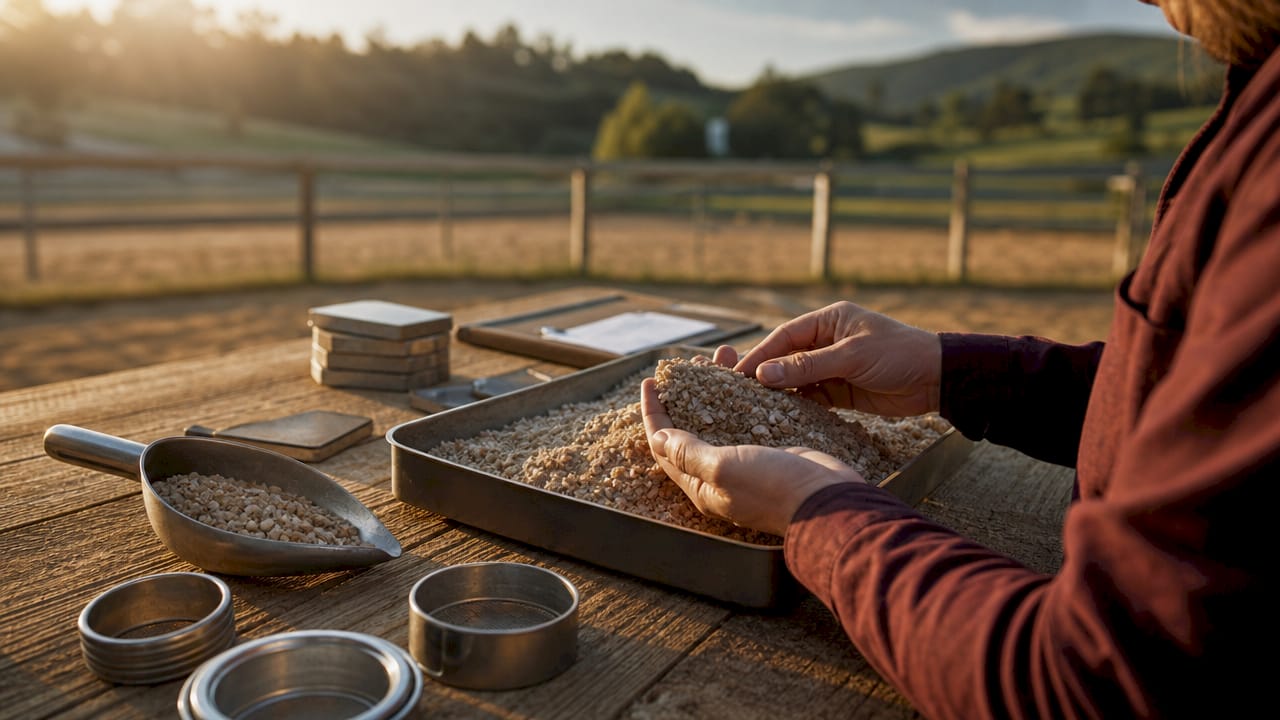
Particle size distribution is where most arena sand specifications fail in practice. The target grading for competition arenas sets 48.50% retention at Mesh 60 (0.25mm) and 34.00% retention at Mesh 100 (0.15mm), with near-zero pan content. Pan content refers to the finest particles that pass through all sieves. High pan content causes dust, surface capping, and compaction. Low pan content keeps the surface free-draining and consistent.
| Grading parameter | Target value | Why it matters |
|---|---|---|
| Silica (SiO₂) content | 95% minimum | Resists breakdown under repeated loading |
| Grain shape | Sub-angular | Interlocks under load, releases cleanly |
| Mesh 60 retention (0.25mm) | 48.50% | Controls surface stability and cushion |
| Mesh 100 retention (0.15mm) | 34.00% | Balances drainage and surface firmness |
| Pan content | Near zero | Prevents dust, capping, and compaction |
Drainage performance ties directly to grading. A well-graded silica sand with the correct particle distribution drains freely after heavy rain, which is critical for outdoor competition venues in the UK. Sand that is too fine retains water and becomes heavy. Sand that is too coarse drains too fast and dries out, creating a loose, unstable footing.
Pro Tip: Request a full sieve analysis certificate from your sand supplier before purchase. Any reputable supplier of competition-grade sand will provide this as standard. If they cannot, the sand is not specification grade.
How to determine the optimal surface depth and layering for different disciplines
Surface depth is one of the most consequential decisions in arena construction, and one of the most frequently misjudged. The recommended riding layer depth for competition arenas is 50–75mm (2–3 inches). That range applies to the top riding layer only, not the total construction depth.
Discipline determines where within that range you should sit:
Dressage arenas perform best at 50–60mm. Dressage requires a firm, consistent surface that supports collected work and lateral movements. Too much depth creates instability under piaffe and passage, where the horse carries significant weight on the hindquarters.
Showjumping arenas work well at 60–70mm. The surface needs enough cushion to absorb landing impact but enough firmness to support take-off. A surface that is too deep increases the risk of tendon strain on landing.
Cross-country training arenas can run at 65–75mm, with rubber crumb additives extending the cushion range. Rubber additive depths vary by discipline, from 10mm for polo surfaces to 35mm for cross-country training.
All-discipline arenas are best set at 60–65mm with a fibre blend to balance the competing demands of different work types.
The risk of getting depth wrong runs in both directions. A surface that is too shallow transmits concussion directly to the horse’s joints and increases the risk of bruising and stress fractures. A surface that is too deep creates excessive resistance on every stride, loading the tendons and suspensory ligaments with each step. Neither failure is visible until the horse is lame.
Pro Tip: Use a penetrometer to measure surface firmness before and after installation. A competition surface should register consistent readings across the whole arena, not just in the centre track. Variation in readings indicates uneven depth or compaction.
Fibre additives change the depth equation. A sand and fibre blend at 60mm performs differently from pure sand at 60mm. Fibre holds the sand particles together, reduces migration, and adds a degree of resilience that allows a slightly shallower total depth without sacrificing cushion. Rubber crumb additives work differently again, adding bounce and shock absorption rather than binding the surface. Understanding how each additive changes the performance profile is essential before specifying depth.
What are the best practices for sub-base construction and drainage?
The sub-base is the part of an arena that riders never see and project managers most often underspecify. Ignoring the sub-base causes surface failure regardless of how well the top layer is specified. Water pooling, surface shift, and uneven compaction all originate below the riding layer.
A correctly constructed sub-base follows this sequence:
Subgrade preparation. Strip topsoil and organic material to a consistent depth. Carry out a geotechnical assessment to identify any soft spots, clay lenses, or drainage issues in the natural ground. Soft subgrades must be stabilised before any construction begins.
Geotextile membrane. Lay a woven geotextile directly on the prepared subgrade. The membrane separates the sub-base aggregate from the natural ground, preventing fines migration upward and maintaining the integrity of the drainage layer over time. Equestriansurfacesolutions supplies woven and non-woven arena membrane options suited to different ground conditions.
Compacted Type 1 aggregate base. Install a 100–150mm (4–6 inch) layer of crushed rock Type 1 aggregate and compact it to a minimum 95% Proctor density. This layer provides the structural platform for everything above it.
Drainage aggregate and pipe network. Lay a drainage aggregate layer over the Type 1 base, incorporating perforated drainage pipes sized to local rainfall intensity. Pipes should run to a discharge point at a gradient sufficient to prevent standing water. Inadequate pipe sizing is one of the most common causes of arena surface problems in the UK, where rainfall can be sustained and heavy.
Surface membrane. A second geotextile or specialist arena membrane separates the drainage aggregate from the riding surface, preventing sand migration downward while allowing water to pass freely.
Each layer depends on the one below it. Skipping the geotechnical assessment is the single most expensive mistake in arena construction. A sub-base built on unidentified soft ground will settle unevenly, creating high and low spots in the riding surface within the first season.
How to select and maintain arena surface materials for long-term performance
Selecting the right material blend depends on discipline, budget, and the intensity of use the arena will see. The table below summarises the main options for competition arenas.
| Surface type | Best for | Key advantage | Key limitation |
|---|---|---|---|
| Washed silica sand (standalone) | Dressage, light jumping | Low cost, easy to source | Migrates and compacts without additive |
| Sand and synthetic fibre blend | All-discipline, competition | Stable, consistent, low dust | Higher initial cost than sand alone |
| Sand and rubber crumb blend | Jumping, cross-country training | High shock absorption | Can become loose if rubber depth is excessive |
| Standalone fibre surface | All-weather, budget-conscious | Up to 80% cheaper than engineered blends | Less suitable for top-level FEI competition |
For competition venues, a sand and fibre blend is the most widely used specification. Washed silica sand with a 5–10% synthetic fibre mix delivers consistent performance for private and club-level competition arenas without the cost of laboratory-engineered products. Elite FEI venues typically specify proprietary engineered blends, but these require certified installation to maintain manufacturer warranties.
Maintenance is where most competition arenas lose performance over time. The key practices are:
Regular harrowing. Harrow after every session to redistribute surface material and prevent compaction tracks forming along the centre line and at fence approaches.
Deep decompaction. Use a deep-tine decompactor at least twice per year to break up compaction below the harrowing depth. This is the single most effective maintenance intervention for preserving surface consistency.
Sand topping up. Periodic sand top-ups every few years restore depth lost through migration and use. A well-maintained surface can last 7–10 years or more before full replacement is needed.
Surface monitoring. Watch for signs of failure: dust clouds during use, visible compaction tracks that do not respond to harrowing, water pooling after rain, or uneven footing that causes horses to stumble or hesitate at fences.
When these signs appear, address them before the next competition. A surface that is failing mid-season is a horse welfare issue, not just a maintenance inconvenience.
Key takeaways
A competition arena surface performs reliably only when sand grading, riding layer depth, and sub-base construction are specified and built together as a single engineered system.
| Point | Details |
|---|---|
| Sand specification is non-negotiable | Use 95% minimum silica content with sub-angular grains and correct particle grading. |
| Depth varies by discipline | Set riding layer depth between 50–75mm based on the primary discipline using the arena. |
| Sub-base determines longevity | A 4–6 inch compacted Type 1 base with geotextile and drainage pipes prevents surface failure. |
| Maintenance extends surface life | Deep decompaction and sand top-ups preserve performance for 7–10 years or more. |
| Certified installation protects investment | Elite engineered blends require manufacturer-certified crews to maintain warranty validity. |
Why I think most arena projects fail before a single horse steps on the surface
The conversations I have with equestrian professionals consistently reveal the same pattern. The riding surface gets all the attention and the budget. The sub-base gets whatever is left. That is the wrong order of priority, and it is why so many competition arenas develop problems within two or three seasons.
A geotechnical assessment costs a fraction of the total project budget. It tells you what you are actually building on. Without it, you are guessing, and the consequences of guessing wrong show up as uneven settlement, drainage failure, and a surface that cannot be corrected without stripping everything back to the subgrade.
The other issue I see regularly is the gap between what riders want and what they specify. Riders want a surface that feels right. Specifiers need a surface that can be measured, tested, and reproduced. Those two things are not in conflict, but they require different conversations. A sieve analysis certificate and a penetrometer reading are not bureaucratic requirements. They are the evidence that the surface you are riding on is what it claims to be.
My recommendation for any competition arena project is to spend the money on the sub-base and the sand specification first. Get those right, and the choice of fibre or rubber additive becomes a refinement rather than a rescue. Get them wrong, and no additive will save you.
Professional arena surface materials from Equestriansurfacesolutions

Equestriansurfacesolutions supplies the full range of materials needed to build or refurbish a competition arena to specification, from premium washed silica sand graded to competition standards through to synthetic fibre blends, rubber additives, and drainage membranes. Every product is selected for performance under UK conditions, and the team provides technical support to help you match materials to your discipline, ground conditions, and budget. Whether you are commissioning a new FEI-standard arena or upgrading an existing surface, you can request a personalised quote through the Equestriansurfacesolutions website or speak directly with the team for bespoke specification advice. Ride with confidence, knowing the surface beneath you is built to last.
FAQ
What silica content does competition arena sand require?
Competition-grade arena sand requires a minimum 95% silica (SiO₂) content. This level of purity ensures the sand resists breakdown under repeated loading from horses in competition.
How deep should a competition arena riding surface be?
The recommended riding layer depth for competition arenas is 50–75mm (2–3 inches). Dressage arenas sit at the shallower end of that range, while cross-country training arenas benefit from the full depth with rubber additive.
Why does sub-base construction matter for arena surfaces?
A poorly constructed sub-base causes water pooling and surface shift regardless of the quality of the top layer. A 4–6 inch compacted crushed-rock base with geotextile membrane and drainage pipes is the minimum standard for a stable competition surface.
How often should a competition arena surface be maintained?
Harrow after every session and carry out deep decompaction at least twice per year. Top up sand every few years to restore depth. A well-maintained surface lasts 7–10 years or more before full replacement is needed.
Do engineered arena blends require certified installation?
Yes. Most premium footing manufacturers require installation by certified crews to maintain warranty validity. Private arenas often perform well with high-quality washed silica sand and a 5–10% synthetic fibre mix, which does not carry the same installation requirement.
