

For dressage and general schooling, a well-specified silica sand and fibre blend is the best all-round choice for UK performance horses.
Show jumping arenas benefit from a sand and rubber mix or a premium engineered blend that delivers higher shock absorption and energy return. Eventing schooling yards typically use a sand and fibre combination with a slightly deeper top layer, while reining and cutting disciplines require a surface that allows controlled slide alongside reliable grip.
Industry guidance from STRI and the FEI consistently points to top-layer depth as the single most controllable variable in surface safety. Research confirms that thinning the top layer below the recommended 2-inch minimum directly increases impact shock and injury risk. Equestrian Surface Solutions supplies specialist silica sands, fibre blends, rubber additives, and complete self-build arena kits across the UK, with material selection guided by discipline, base condition, and maintenance capacity.
Quick picks by discipline:
- Dressage: Washed silica sand + fibre blend, a depth just over the recommended minimum
- Show jumping: Sand + rubber mix or engineered wax-coated blend, a depth slightly deeper than the standard range
- Eventing schooling: Sand + fibre with good drainage membrane, a moderate depth appropriate for most eventing schooling yards
- Reining / cutting: Controlled-slide sand blend with low rubber content, a moderate depth appropriate for most reining and cutting yards
- General schooling / lesson yards: Plain washed silica sand or sand + fibre, a depth just over the recommended minimum
- Turnout / paddocks: Stonedust compacted base or woodchip, depth to suit traffic level
Table of Contents
- How do the main footing types compare at a glance?
- What you need to know about silica sand and sand-based mixes
- When does a fibre-based surface outperform plain sand?
- What are the real benefits and risks of rubber in arena surfaces?
- Are engineered and wax-coated blends worth the premium?
- Where do woodchip, organic surfaces, and stone dust fit in?
- How do you match footing to your discipline and yard priorities?
- What does installation, maintenance, and cost look like in practice?
- How does footing affect soundness and long-term horse health?
- How Equestrian Surface Solutions specifies and supplies UK arena surfaces
- Guidelines for mixing and layering footing materials
- Health and safety beyond joint impact: dust, allergens, and rider welfare
- Key takeaways
- The specification mistake most yards make
- Equestrian Surface Solutions: getting the right spec for your arena
- Further reading and authoritative sources
- FAQ
How do the main footing types compare at a glance?
The table below compares the seven principal footing categories on the dimensions that matter most to UK facility managers. Costs are indicative ranges; actual figures depend on arena size, base condition, and supplier.
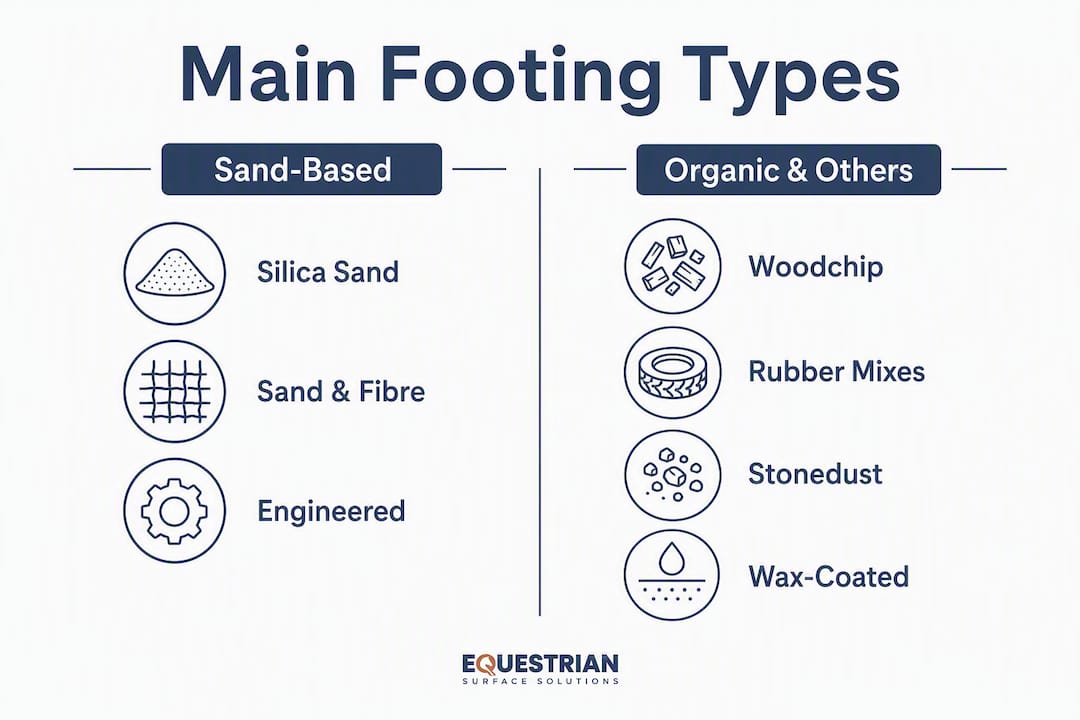
| Footing type | Best for | Shock absorption / firmness | Traction / slip risk | Maintenance effort | Drainage & weather (UK) | Dust / respiratory | Installation depth |
|---|---|---|---|---|---|---|---|
| Silica sand (plain) | General schooling, lesson yards | Moderate firmness | Good when moist; slippery if dry | Daily watering + harrowing | Good with crown; freezes if wet | Moderate; silica dust risk if dry | 2–2.5 inches |
| Sand + fibre blend | Dressage, schooling, all-weather | Firm with cushion | Consistent; fibres reduce slip | Regular harrowing; less watering | Excellent; fibres retain moisture | Low; fibres bind particles | 2–2.5 inches |
| Sand + rubber mix | Showjumping, rehab work | High cushion | Good; rubber adds grip | Harrowing to prevent drift | Good; rubber insulates against frost | Low | 2.5–3 inches |
| Engineered / wax-coated blend | Competition, elite training | Very consistent | Highly stable | Manufacturer-specified regime | Excellent all-weather | Very low | Manufacturer-specified, typically 2.5–3 inches |
| Rubber chippings | Jumping, horses with soundness history | High cushion | Good; can drift on slopes | Periodic re-levelling | Good; insulates in frost | Low | 2.5–3 inches |
| Woodchip / organic | Paddocks, low-traffic turnout | Moderate cushion | Variable; degrades over time | Topping up as material decomposes | Moderate; can waterlog | Moderate when dry | 12 inches for paddocks, lower for turnout |
| Stonedust / compacted base | Hardstanding, high-traffic areas | Firm; low cushion | Good when compacted | Low; occasional re-compaction | Good; stable in wet | Low | 2–3 inches for base layer |
What you need to know about silica sand and sand-based mixes
Sand is the foundation of most UK arena surfaces, but not all sand performs equally. Washed silica sand with rounded to sub-angular particles and a consistent gradation provides the traction and drainage characteristics that performance horses need. Concrete sand and builder’s sand tend to have angular, poorly graded particles that compact quickly, create hard spots, and generate more dust. The particle shape and size distribution directly govern how the surface behaves underfoot: too fine and it packs solid; too coarse and it shifts unpredictably.
Quality silica sand for equestrian use is washed to remove clay fines that cause dust and compaction. This matters particularly in the UK, where arenas are used year-round in wet conditions that accelerate clay migration into the riding layer.
Plain washed silica sand:
- Pros: low cost, widely available, good drainage when correctly graded, easy to top up
- Cons: dries out quickly in summer, can become slippery when dry, offers limited cushion without additives, susceptible to freeze-thaw displacement
Sand + fibre blend:
- Pros: fibres knit the sand matrix for stability, retain moisture, reduce dust, and improve consistency across seasons
- Cons: higher initial cost than plain sand, requires regular harrowing to maintain even fibre distribution
Sand + rubber mix:
- Pros: rubber particles increase cushion and energy return, reduce compaction, and extend the working life of the sand
- Cons: rubber can drift to low spots if the arena crown is insufficient; outdoor arenas may experience heat gain and odour in summer
Depth matters more than most yards realise. Research published by The Horse confirms that cutting the top layer below 2 inches directly correlates with increased impact shock and a higher risk of lameness. The recommended ranges are 2–2.5 inches for dressage and 2.5–3 inches for jumping and reining; exceeding 3 inches increases tendon strain rather than reducing it.
The sub-base beneath the riding layer is equally consequential. An arena is effectively a three-layer system: the riding top layer, a stone-dust sub-base, and a crushed-rock base. The base largely determines how long the surface lasts, which is why investing in a sound base before specifying a premium top layer is always the correct order of priority.
When does a fibre-based surface outperform plain sand?
Fibre systems work by interlocking with sand particles to create a more stable, moisture-retentive matrix. The fibres used in equestrian blends are typically shredded synthetic textiles or purpose-made polymer strands, cut to a length that allows them to knit without clumping. Standalone fibre systems, which use fibre as the primary riding material rather than a sand additive, go further still, offering a surface that performs well in cold, wet UK winters without freezing solid.
Dressage riders and competition schooling yards select fibre blends because the surface stays consistent across a session. The fibres prevent the sand from migrating under repeated lateral work, which is the movement pattern most likely to create uneven depth and hard spots. High-mileage training yards benefit from the reduced watering requirement: a well-specified sand-fibre blend typically needs less frequent irrigation than plain sand to maintain the same moisture level.
Where fibre systems add the most value:
- Dressage arenas with heavy lateral and collected work
- All-weather outdoor arenas in the UK’s wetter regions
- Yards where daily watering is impractical
- Competition facilities where surface consistency between sessions is non-negotiable
- Cold-climate situations where standalone fibre prevents freeze-up
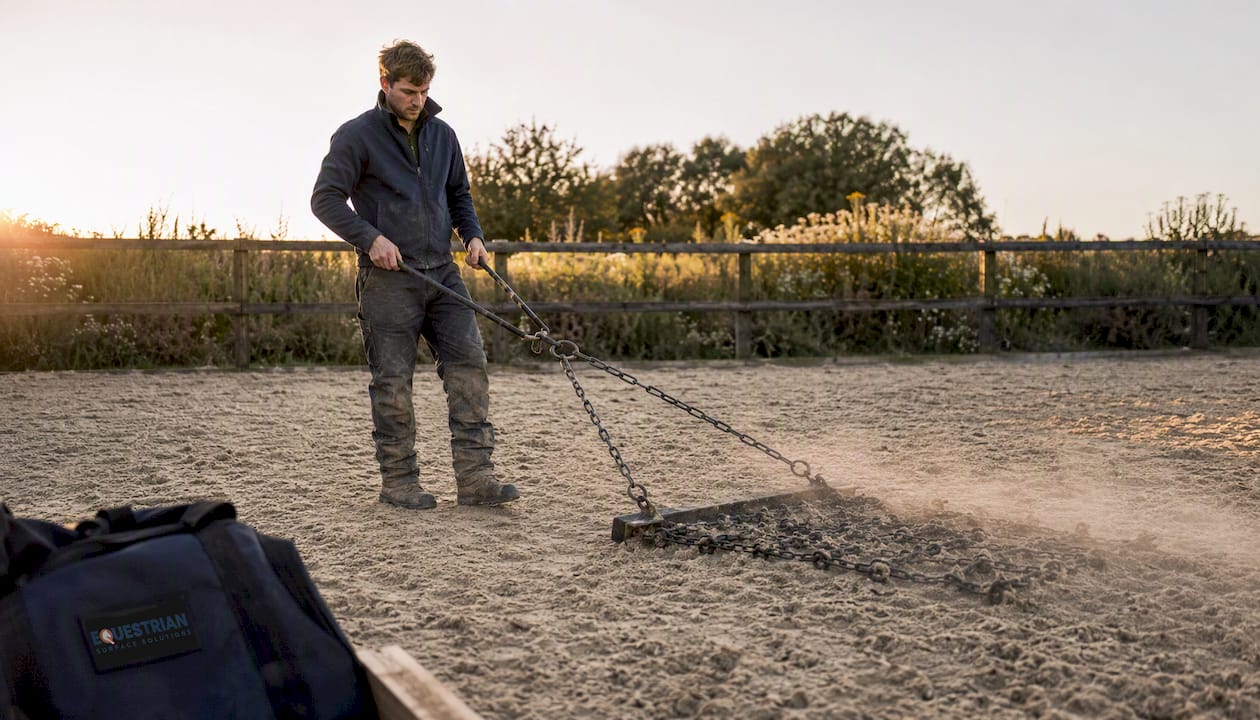
Maintenance for fibre blends centres on regular harrowing to redistribute fibres and maintain even depth. A chain harrow is adequate for light use; a purpose-built arena harrow with tines set to the correct depth gives better results on a busy yard. Rolling after harrowing helps re-consolidate the surface and prevents loose pockets forming at the track.
Pro Tip: Harrow across the diagonal as well as along the long sides of the arena. Diagonal passes redistribute fibre that accumulates in the corners and along the track, where depth loss is most common and most likely to cause injury.
What are the real benefits and risks of rubber in arena surfaces?
Rubber adds cushion and can extend the working life of worn sand, but the quality of the rubber matters as much as the quantity. Crumb rubber is produced by shredding vehicle tyres to a fine granule; rubber chippings are larger, more uniform pieces typically sourced from industrial or equestrian-grade recycling. Both reduce compaction and improve energy return, but they behave differently in a mixed surface.
In a sand and rubber mix, crumb rubber at a typical rate of 10–15% by volume softens the surface without making it unstable. Higher rubber content increases the risk of the surface becoming too deep and unpredictable, particularly for horses working at speed or over fences. Rubber chippings used as a standalone or near-standalone surface deliver high cushion and are well suited to jumping arenas and horses with a history of joint or soft-tissue issues.
Rubber: key considerations for UK yards:
- Crumb rubber from uncertified sources may contain steel wire fragments from tyre belts; always request a contaminant guarantee from your supplier
- Rubber drifts to low spots if the arena does not have an adequate crown; re-levelling is a periodic maintenance requirement
- Outdoor rubber surfaces can retain heat in summer and produce a faint odour; this is generally not a welfare concern but can be noticeable
- Rubber insulates the surface against frost, making it a practical choice for all-weather outdoor arenas in northern England and Scotland
- Granule size affects performance: very fine crumb packs tightly; coarser chippings maintain more air space and cushion
Where rubber is less suitable: high-level dressage arenas where precise, consistent footing is paramount, and any arena where the base crown is insufficient to prevent drift.
Are engineered and wax-coated blends worth the premium?
Engineered top layers, which include wax-coated sand, textile chip blends, and proprietary fibre-wax systems, represent the highest-performing and most expensive footing category. They are the surface of choice at elite competition venues precisely because they deliver consistent moisture behaviour, stable traction, and predictable energy return regardless of weather conditions.
The wax coating on sand particles binds moisture within the surface matrix, which means the footing performs similarly whether it rained overnight or the arena has been dry for a week. Dust is effectively eliminated. Traction remains stable across a session, which matters for horses performing collected movements or jumping at speed where a sudden change in grip can cause injury.
What engineered blends require from you:
- Manufacturer-specified installation depths and sub-base tolerances; deviating from these can void the warranty
- Certified or approved installers in many cases; competition arena specification should always involve a qualified specifier
- A higher upfront investment than sand or sand-fibre surfaces, offset by lower ongoing maintenance costs and a longer lifespan
- Periodic top-dressing with the same proprietary blend to maintain the wax content as it depletes over time
Premium engineered blends dominate elite venues and are increasingly used at commercial training yards where surface downtime is costly. For a private yard with moderate use, the cost-benefit calculation usually favours a quality sand-fibre blend with a sound base over a proprietary engineered system.
Where do woodchip, organic surfaces, and stone dust fit in?
Woodchip and organic footings have a clear role in paddocks, sacrifice areas, and low-traffic turnout zones, but they are not suitable as the primary surface for a performance arena. Wood products add cushioning and moisture retention but decompose over time, and sourcing is critical: generic wood waste from pallets or construction sites frequently contains nails, staples, and toxic hardwood species including walnut and black cherry, which are harmful to horses.
For paddock use, paper-grade white pine woodchip at a depth of around 12 inches provides good cushion and drainage. The material needs topping up as it decomposes, typically annually in a high-traffic paddock. Avoid large chip sizes, which create an uneven surface and increase the risk of horses catching a foot.
Stone dust, also known as limestone screenings or decomposed granite, is the right choice for hardstanding areas, yard surfaces, and high-traffic gateways. It compacts to a firm, stable surface that drains well and withstands heavy use. Adding a proportion of rubber chippings to stone dust improves cushion for horses standing for extended periods.
Where to use each material:
- Woodchip / organic: paddocks, sacrifice areas, low-traffic turnout, short-term schooling on a budget
- Stone dust / compacted base: hardstanding, yard surfaces, gateways, lorry parks, ancillary zones
- Neither material is appropriate as the primary riding surface for a competition or performance arena
Health and safety note: Never use treated timber, pallet wood, or mixed hardwood waste in areas accessible to horses. Walnut and black cherry wood contain compounds toxic to horses even in decomposed form.
How do you match footing to your discipline and yard priorities?
Different disciplines genuinely require different surface profiles, and getting this wrong costs money twice: once in the initial installation and again in veterinary bills.
Dressage demands a firm, stable surface with consistent depth. The horse needs to push off cleanly without the surface shifting, and lateral movements require predictable grip. A washed silica sand and fibre blend at 2–2.5 inches, on a sound stone-dust sub-base with a geotextile membrane, is the standard specification for UK dressage arenas.
Show jumping requires higher shock absorption at landing and reliable energy return at take-off. A sand and rubber mix or a quality engineered blend at 2.5–3 inches suits most jumping arenas. The surface must not be so deep that it creates resistance at take-off, which strains tendons.
Eventing schooling combines flatwork and jumping in the same space, so the surface needs to balance the requirements of both. A sand-fibre blend at 2.5 inches, with good drainage to handle the UK’s wet winters, is the practical choice for most eventing yards.
Reining and cutting require a surface that allows a controlled slide on the hindquarters without the horse losing balance. A lower-fibre sand blend with a smooth, consistent depth achieves this; too much rubber or fibre prevents the slide.
Lesson yards and general schooling see the widest range of horses and riders. Plain washed silica sand or a basic sand-fibre blend at 2–2.5 inches is cost-effective and easy to maintain, provided the base is sound and the arena is harrowed regularly.
Decision checklist:
- Assess your primary discipline and the surface profile it requires (firm/stable vs. high cushion vs. controlled slide)
- Review your horses’ soundness history; horses with tendon or joint issues benefit from more cushion
- Inspect your existing base and drainage; a poor base undermines any top layer
- Audit your maintenance capacity: do you have a harrow, roller, and water supply?
- Set a realistic budget covering both installation and five-year maintenance costs
- Identify red flags before ordering: shallow existing top layer, standing water after rain, inconsistent depth across the arena, or visible hard spots
Red flags that need addressing before any new surface goes down: standing water after 30 minutes of rain, visible ruts deeper than 1 inch, a top layer below 1.5 inches in any zone, and a base that moves underfoot.
What does installation, maintenance, and cost look like in practice?
A well-built arena follows a clear sequence: site clearance and levelling, crushed-rock base construction (typically 6–8 inches), geotextile membrane installation, stone-dust sub-base (2–3 inches), and finally the riding top layer. The base and sub-base determine longevity; skimping on either to save money on the top layer is a common and costly mistake.
The membrane between the sub-base and the riding layer prevents stone migration into the top layer and is one of the most underappreciated components of a well-specified arena. Without it, stone particles work upward through the riding surface within a season or two, creating hard spots and injury risk.
Maintenance schedule:
- Daily: Harrow the full arena surface; water if the top layer is dry
- Weekly: Check depth at multiple points; re-level any areas showing drift or thinning
- Monthly: Roll to re-consolidate the surface; inspect the arena crown and drainage channels
- Annually: Top-dress with fresh material to restore depth; inspect the membrane and sub-base at the arena edge
Consistent harrowing, rolling, and watering are as important as the initial material choice. A premium surface that is not maintained will underperform a modest surface that is cared for properly.
Typical UK cost ranges (indicative):
| Arena type | Top layer material | Indicative cost range (materials + installation) | Expected lifespan |
|---|---|---|---|
| Budget / schooling | Plain silica sand | — | 5–8 years with maintenance |
| Standard | Sand + fibre blend | — | 8–12 years with maintenance |
| Premium | Sand + rubber or fibre-rubber | — | 10–15 years with maintenance |
| Engineered | Wax-coated / proprietary blend | — | 12–20 years with maintenance |
Figures are indicative for a standard 20m x 40m arena in the UK and will vary with site conditions, base work required, and supplier.
Drainage is the most climate-sensitive element for UK arenas. A correctly formed crown of 1:100 fall from the centre to the sides sheds water before it saturates the riding layer. Poor drainage shortens surface life significantly and is the leading cause of arena surface failures in the UK.
How does footing affect soundness and long-term horse health?
Surface properties directly influence how forces travel through a horse’s limbs on every stride. Small changes in depth, composition, or moisture can significantly alter stability and injury risk, which is why surface management is a welfare issue, not just a performance preference.
Too firm a surface transmits concussion directly to the hoof, fetlock, and cannon bone, increasing the risk of stress fractures, bruising, and joint inflammation. Too soft a surface, or one that is too deep, forces the tendons and suspensory ligament to work harder on every stride, raising the risk of soft-tissue injury. The 2–3 inch depth range exists precisely to balance these competing risks.
Veterinary guidance points:
- Horses with a history of tendon or suspensory injury should work on surfaces with adequate cushion; avoid hard, compacted sand
- Horses in controlled rehabilitation may benefit from a firmer surface for short, structured sessions to encourage controlled loading
- Respiratory health is affected by dust: silica dust from dry sand is a known irritant, and horses with equine asthma or recurrent airway obstruction should work on a well-watered or fibre-bound surface
- Uneven depth creates asymmetric loading; a surface that is 2 inches deep on one rein and 1 inch on the other will produce asymmetric muscle development and gait changes over time
Habituating horses to a new surface gradually protects the musculoskeletal system during the adaptation period. A practical plan: begin with walk work only for the first three to five sessions, introduce trot work in the second week, and reserve canter and collected work until the horse moves freely and symmetrically on the new surface.
Cutting costs on top-layer depth is a false economy. Short-term savings on material volume consistently create higher veterinary and replacement costs within two to three seasons.
How Equestrian Surface Solutions specifies and supplies UK arena surfaces
Equestrian Surface Solutions supplies the full range of materials needed to build or refurbish a performance arena in the UK: specialist washed silica sands, sand-fibre blends, rubber additives, geotextile membranes, drainage products, and complete self-build arena kits. The product range maps directly to the discipline recommendations in this article, from a basic silica sand for a schooling yard to a premium fibre blend for a competition dressage arena.
The specification process starts with the yard’s use profile: discipline, horse numbers, maintenance capacity, and existing base condition. These factors determine which material combination will perform best and last longest. For yards with an existing arena, a top-up or refurbishment with the correct material is often more cost-effective than a full rebuild.
What to prepare before requesting a spec:
- Arena dimensions (length x width in metres)
- Current top-layer material and approximate depth
- Primary discipline and number of horses using the arena daily
- Existing drainage: does water clear within 30 minutes of heavy rain?
- Base condition: is the surface level, or are there ruts and soft spots?
Pro Tip: When you contact Equestrian Surface Solutions for a quote, send three photographs: one of the full arena from a corner, one close-up of the existing surface showing depth and texture, and one taken immediately after rain showing drainage behaviour. These three images allow a specifier to identify the most likely issues and recommend the correct material without a site visit in most cases.
Guidelines for mixing and layering footing materials
Mixing footing materials is not simply a matter of adding rubber or fibre to sand and hoping for the best. The proportions, particle sizes, and layering sequence all affect how the finished surface performs and how long it lasts.
The most reliable approach is to specify materials from a single supplier who can confirm compatibility between components. Sand particle size must be matched to fibre length and rubber granule size; mismatched components separate under use, with heavier particles sinking and lighter ones migrating to the surface.
For a sand-fibre blend, the fibre is typically incorporated during installation by spreading it over the sand and harrowing it in, rather than pre-mixing off-site. This allows the installer to achieve an even distribution across the full depth of the top layer. Rubber is usually added in a similar way, spread over the existing sand surface and harrowed to the correct depth.
Layering is different from mixing. Some yards apply a thin rubber layer over an existing sand base to add cushion without replacing the whole surface. This works well when the existing sand is in good condition and the correct depth; it is not a substitute for addressing a shallow or contaminated base layer. The rubber layer must be harrowed into the sand rather than left sitting on top, or it will drift and create uneven depth.
Key principles for mixing and layering:
- Match particle sizes across all components to prevent separation
- Incorporate additives by harrowing in, not surface-spreading
- Never layer new material over a contaminated or structurally compromised base
- Maintain the total top-layer depth within the 2–3 inch range after all components are incorporated
- Re-check depth at multiple points after the first week of use, as new material settles
Health and safety beyond joint impact: dust, allergens, and rider welfare
Dust is the most underestimated health risk in arena management, and it affects both horses and riders. Silica dust from dry sand is a respiratory irritant; prolonged exposure is associated with equine asthma and, in humans, with occupational respiratory conditions. Watering the arena before use and after harrowing is the primary control measure, but the type of footing material also makes a significant difference.
Fibre-bound surfaces and rubber-sand mixes generate substantially less airborne dust than plain dry sand because the additives bind the fine particles. Wax-coated engineered surfaces produce the least dust of any footing type. For horses with diagnosed equine asthma or recurrent airway obstruction, a fibre blend or wax-coated surface is not a luxury but a clinical recommendation.
Allergen risks are less commonly discussed but relevant for organic footings. Decomposing woodchip and organic matter can harbour mould spores, which are potent respiratory allergens for both horses and riders. This is another reason to avoid organic footings in enclosed or poorly ventilated indoor arenas.
Rider and horse health checklist:
- Water the arena before the first session of the day and after harrowing to suppress dust
- Horses with respiratory conditions should not work on dry, un-watered sand surfaces
- Organic footings in indoor arenas increase mould spore exposure; use only in well-ventilated outdoor spaces
- Riders working in dusty arenas should consider respiratory protection, particularly during harrowing
- Check rubber chippings for metal contaminants at installation; request a written guarantee from your supplier
- Uneven depth creates asymmetric loading that can cause subtle gait changes before overt lameness appears; depth checks are a welfare task, not just a maintenance one
Ventilation in indoor arenas amplifies or mitigates all of the above. A well-ventilated indoor arena with a fibre-bound surface and a consistent watering regime is the safest environment for horses with respiratory sensitivities and for riders who spend long hours in the arena.
Key takeaways
The single most important decision in arena footing is matching top-layer depth and material to your primary discipline, because depth below 2 inches raises injury risk regardless of how good the material is.
| Point | Details |
|---|---|
| Match material to discipline | Dressage needs a firm sand-fibre blend at 2–2.5 inches; jumping needs more cushion at 2.5–3 inches. |
| Never go below 2 inches | Research confirms that a top layer below 2 inches increases impact shock and lameness risk directly. |
| Base quality determines lifespan | The crushed-rock base and stone-dust sub-base decide how long any top layer lasts; invest here first. |
| Maintenance is non-negotiable | Daily harrowing and watering matter as much as material choice; poor maintenance degrades premium surfaces. |
| Equestrian Surface Solutions | Supplies specialist silica sands, fibre blends, rubber additives, and self-build kits matched to your discipline and base condition across the UK. |
The specification mistake most yards make
The most common error in arena specification is not choosing the wrong material. It is choosing the right material and then installing it at the wrong depth, or failing to maintain that depth once the arena is in use.
Yards routinely specify a quality sand-fibre blend, install it correctly at 2.5 inches, and then allow the track to thin to under an inch within six months because harrowing is infrequent and top-dressing is deferred. The surface looks fine from the gate. The horses tell a different story: shortened strides on the track, reluctance to work on one rein, subtle changes in way of going that the vet eventually traces back to asymmetric loading on a surface that has lost its depth where it is used most.
The corrective habit is simple: check depth at five points across the arena every week, including both long sides and both short ends. If any point reads below 2 inches, top-dress before the next session. A depth gauge costs very little; the veterinary bill for a tendon injury costs considerably more.
Specification is also not a one-time decision. As horses, disciplines, and yard usage change, the surface specification should be reviewed. A yard that adds a competition horse to a general schooling programme may find that its existing plain sand surface no longer meets the demands being placed on it.
Equestrian Surface Solutions: getting the right spec for your arena
Choosing the correct footing material is straightforward when you have the right information and a supplier who understands how UK arenas actually perform across four seasons. Equestrian Surface Solutions offers something more useful than a product catalogue: a specification service that matches material to discipline, base condition, and maintenance capacity before any order is placed.
Whether you are building a new arena from scratch, refurbishing a tired surface, or adding rubber or fibre to extend the life of an existing sand base, the range covers every stage: specialist silica sand, fibre blends, rubber additives, geotextile membranes, drainage products, and complete self-build arena kits. The process starts with your arena dimensions, your discipline, and a few photographs. From there, a specifier can recommend the correct material combination, confirm the depth and layering sequence, and provide a clear quote with lead times.
To request a specification and quote, visit the Equestrian Surface Solutions quote page and include your arena dimensions, current surface condition, primary discipline, and drainage notes. Most enquiries receive a specification recommendation within two working days.
Further reading and authoritative sources
- Horse arena footing facts | The Horse — Research-backed overview of depth requirements, maintenance, and habituation for performance horses.
- Horse arena footing: materials, layers, best picks | US Patriot Steel — Detailed layer-by-layer breakdown of arena construction and engineered blend specifications.
- Equestrian Surface Solutions: arena footing for all disciplines — Supplier guidance on material selection by discipline for UK arenas.
- Arena maintenance guide | Equestrian Surface Solutions — Practical maintenance schedule and equipment guidance for UK arena owners.
- Arena surface performance issues | Equestrian Surface Solutions — Diagnosis and remediation of common UK arena surface failures.
FEI and STRI publish technical guidance on competition surface standards; contact them directly for the most current specifications applicable to affiliated competition venues.
FAQ
What is the best footing material for an indoor horse arena?
A washed silica sand and fibre blend at an ideal top-layer depth range for performance footing depth is the most widely recommended material for indoor arenas in the UK, offering consistent traction, low dust, and reliable performance across disciplines. For competition or high-mileage facilities, a wax-coated engineered blend delivers the most stable and dust-free surface.
What is the best footing for horses in a paddock?
Stone dust or compacted limestone screenings provide a firm, stable, and well-draining paddock surface for high-traffic areas; woodchip at 12 inches depth suits lower-traffic turnout zones where cushion is a priority. Neither material is appropriate as a primary arena surface for performance work.
What is the best hardstanding for horses?
Compacted stone dust or crushed limestone screenings are the standard choice for hardstanding areas around stables and yards, as they drain well, compact firmly, and withstand heavy foot and vehicle traffic. Adding a proportion of rubber chippings improves cushion for horses standing for extended periods.
How deep should arena footing be for performance horses?
Research recommends 2–2.5 inches for dressage arenas and 2.5–3 inches for jumping and reining; going below 2 inches increases impact shock and injury risk, while exceeding 3 inches raises tendon strain. Depth should be checked at multiple points across the arena weekly and topped up before it falls below 2 inches.
How do I choose the right equestrian arena footing for my yard?
Start with your primary discipline and horses’ soundness history, then assess your existing base condition and drainage before selecting a material. Equestrian Surface Solutions offers a specification service that matches material to discipline, base, and maintenance capacity; a quote request with arena dimensions, photographs, and use profile is the fastest route to an accurate recommendation.
