
The surface your horse trains on every day is one of the most direct influences on hoof health, soft tissue integrity, and long-term soundness. No single “perfect” surface exists; the right choice depends on discipline, horse type, climate, and how well the surface is maintained. What is consistent across all disciplines is this: a poorly chosen or neglected surface accumulates damage in tendons, ligaments, and hoof structures long before any visible lameness appears.
The key factors governing how a surface interacts with the hoof are:
- Cushioning: the surface’s ability to absorb vertical impact forces on landing and loading
- Shear resistance: the horizontal grip that prevents excessive hoof slide during propulsion and turning
- Compaction: how tightly particles pack under repeated traffic, reducing shock absorption over time
- Moisture content: the binding agent that holds particles together and controls dust
- Consistency: uniformity across the whole arena, preventing the gait adaptations that cause repetitive strain
Table of Contents
- What does the horse’s hoof actually do on an arena surface?
- How biomechanical phases put the hoof under stress
- Which surface properties matter most for hoof health?
- Common UK arena footing materials: benefits and challenges
- How to maintain your arena surface to protect hoof health
- UK expert insights: what veterinary and biomechanical research tells us
- Equestrian Surface Solutions: materials built for UK hoof health
- Key takeaways
- FAQ
What does the horse’s hoof actually do on an arena surface?
Understanding the hoof’s structure makes it far easier to judge why surface properties matter so much. The hoof is not a passive block of keratin. It is a dynamic, load-bearing structure with several distinct components, each playing a specific role in how the horse interacts with the ground beneath it.
- Hoof wall: the outer shell of hard keratin that bears the initial ground contact and transmits concussive forces upward through the limb
- Sole: the slightly concave underside that provides secondary protection and limited weight-bearing, particularly on uneven ground
- Frog: the rubbery, V-shaped structure at the heel that acts as a natural shock absorber and aids circulation within the foot
- Digital cushion: a fibrous, fatty pad sitting above the frog that dissipates energy during loading; its quality varies significantly between horses and deteriorates with poor hoof care
- Laminae: the interlocking tissue connecting the hoof wall to the pedal bone; under excessive or uneven loading, these structures are vulnerable to inflammation (laminitis) and mechanical failure
Each of these structures responds differently to surface properties. A hard, compacted surface transmits more concussive force through the hoof wall and laminae. A surface that is too deep or loose forces the frog and digital cushion to work harder, increasing fatigue in the soft tissues above. Balance matters too: an unbalanced hoof places asymmetric load on the laminae and sole, and a surface that exaggerates this imbalance compounds the problem with every stride.
Pro Tip: Ask your farrier to assess hoof balance specifically in the context of your arena surface. A horse shod for hard ground may need a different approach on a deep fibre surface, and vice versa.
The condition of the solar surface and the choice of shoes or barefoot working also shape how the hoof contacts the footing. The FEI’s white paper on equine surfaces notes that hoof balance, shoe type, stud configuration, and solar surface condition all influence the friction, traction, and damping experienced during the loading phase of each stride. Changing any one of these variables without adjusting the surface can shift load distribution in ways that increase injury risk.
How biomechanical phases put the hoof under stress
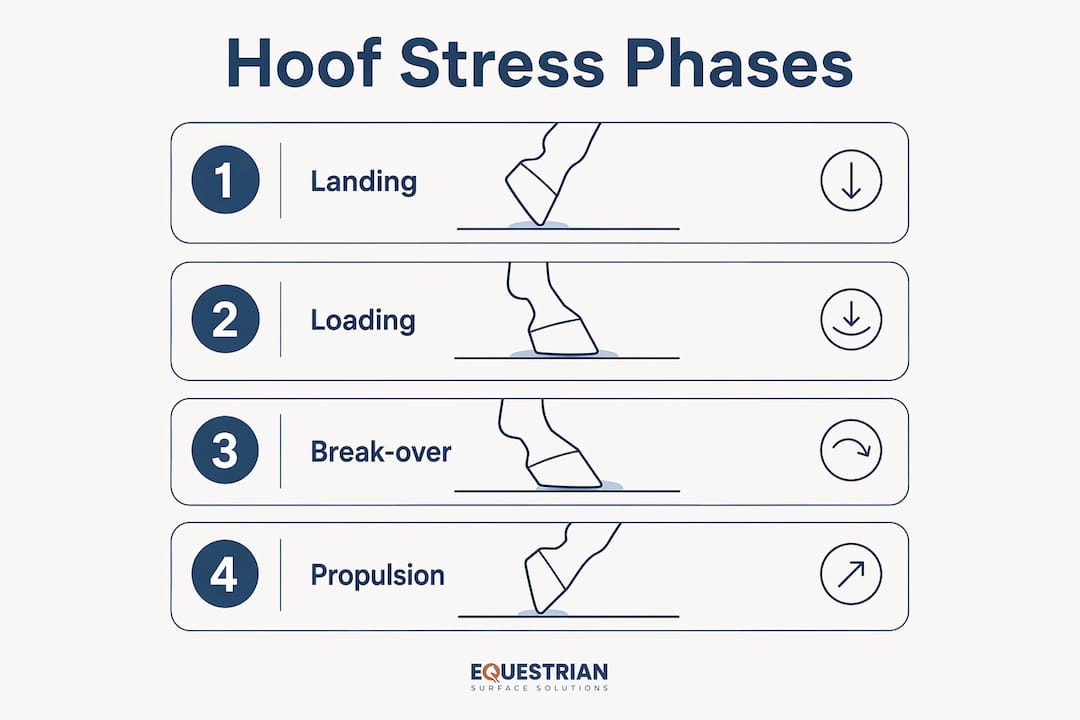
Every stride a horse takes involves three distinct phases of hoof-ground contact, and each one places different demands on both the hoof and the surface beneath it.
1. Landing
The hoof contacts the surface heel-first at walk and trot, or toe-first at canter and during jumping. At this moment, the surface must absorb a rapid vertical impact. A surface that is too hard returns this energy directly into the hoof wall and up through the limb, increasing the risk of concussive injuries including bruised soles, pedal bone stress, and joint damage. A surface that is too deep slows the landing phase, placing greater eccentric load on the flexor tendons as they resist the sinking motion.
2. Loading (stance phase)
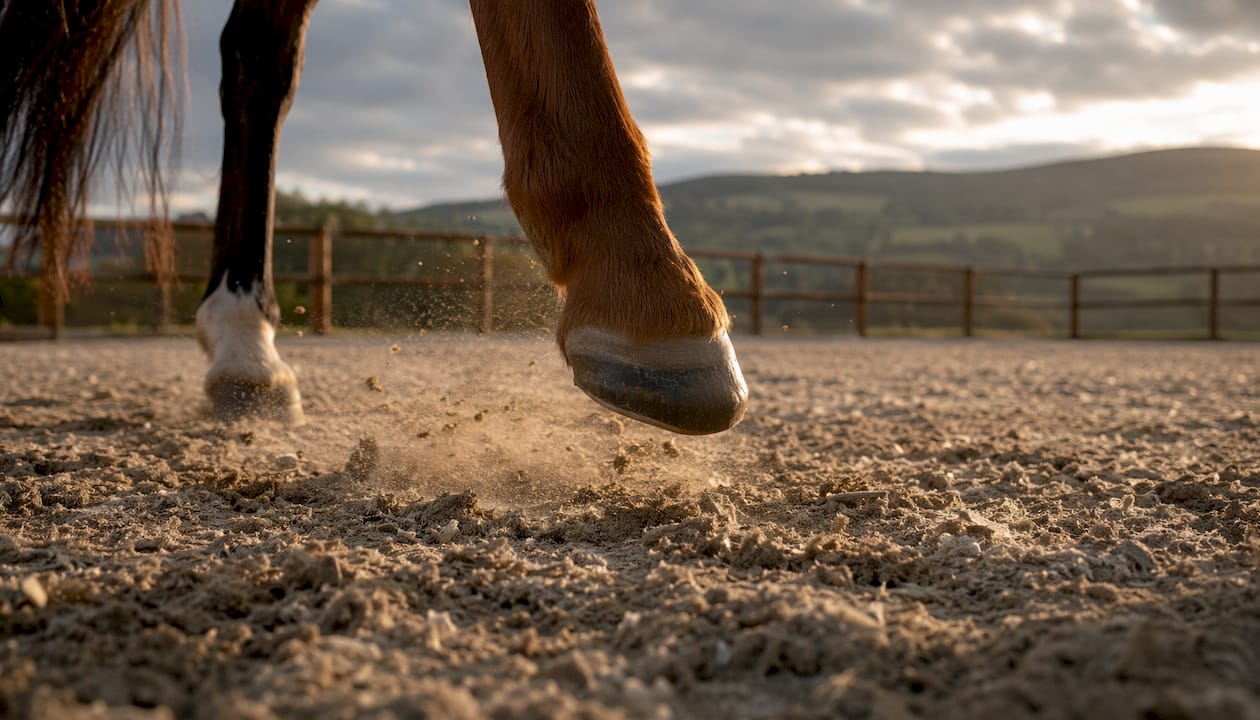
Once the hoof is flat on the ground, the horse’s full bodyweight passes through the limb. This is when shear forces become critical. The surface must provide enough horizontal resistance to prevent the hoof from sliding, while not gripping so firmly that rotational forces are transmitted directly into the fetlock and pastern joints. Research published in Animals confirms that hoof deceleration during slide is significantly greater in the leading limb during jumping, linking rapid deceleration to elevated risk of subchondral bone and cartilage damage. Surface shear properties directly influence this deceleration.
3. Break-over and propulsion
As the horse pushes off, the hoof rolls over the toe and the surface must release cleanly. A surface with excessive grip at this stage resists the natural break-over, increasing strain on the deep digital flexor tendon and the navicular apparatus. Surfaces that are too loose offer insufficient purchase, forcing the horse to work harder for the same propulsive output and accelerating fatigue.
Pro Tip: Watch your horse’s hoof print after each session. Deep, dragged toe marks suggest the surface is too deep or sticky at break-over. Shallow, skidded prints suggest insufficient shear resistance at landing.
Tendon and ligament injuries often result from cumulative micro-damage caused by subtle surface changes rather than single traumatic events. A surface that shifts between sessions, or that has hard spots from uneven compaction, forces constant gait adjustments that load soft tissues inconsistently and progressively.
Which surface properties matter most for hoof health?
Surface properties are not fixed. They change with weather, use intensity, and maintenance frequency. Understanding what each property does helps you manage your arena proactively rather than reactively.
- Cushioning: absorbs vertical impact energy. Too little cushioning increases concussion to the hoof wall, joints, and pedal bone. Too much increases tendon workload and fatigue. The ideal sits in a middle range that varies by discipline and horse weight.
- Shear resistance: governs horizontal grip. Jumping surfaces need higher shear strength to support rapid direction changes and landing forces. Flatwork and dressage arenas benefit from slightly lower shear to allow the natural rotational movement of collected work.
- Firmness: the surface’s resistance to vertical deformation. Mechanical properties vary with horse weight and activity intensity, meaning a surface that feels appropriate for a lightweight pony may behave very differently under a 600kg warmblood in extended canter.
- Moisture content: the single most controllable variable in daily management. Proper watering reduces dust, maintains particle binding, and preserves footing uniformity. An under-watered sand surface becomes loose and dusty; an over-watered one becomes heavy and compacted.
- Texture and particle shape: angular particles interlock and resist compaction better than rounded ones. This is why sub-angular silica sand outperforms river sand in arena applications.
- Consistency across the arena: uneven or inconsistent surfaces cause horses to alter gait frequently, increasing fatigue and injury risk through repetitive biomechanical stress. High-traffic zones along the track and near jumps compact faster than the centre, creating surface gradients that the horse must constantly compensate for.
Dust deserves specific mention. Horses inhale large volumes of air during exercise, and a dusty arena poses genuine respiratory risks to both horse and rider. Dust control through footing selection and moisture management is not a cosmetic concern; it is a welfare priority.
Common UK arena footing materials: benefits and challenges
The UK’s wet winters, variable springs, and occasional summer droughts place specific demands on arena surfaces that differ from continental European or North American conditions. The materials below are the most widely used in British equestrian facilities, each with distinct profiles for hoof health and maintenance.
| Material | Shock absorption | Shear resistance | Dust risk | Maintenance demand | Typical UK suitability |
|---|---|---|---|---|---|
| Silica sand (medium-coarse) | Moderate | Good | Moderate without watering | Regular harrowing and watering | Excellent base for most disciplines |
| Fibre-blended surface | Good | Moderate-good | Low | Moderate; top-ups needed | Excellent all-weather, year-round |
| Rubber chippings | Good | Moderate | Very low | Low-moderate | Good for all-weather; suits rehab and barefoot |
| Woodchip footing | Moderate | Low-moderate | Low | High; decomposes over time | Suitable short-term or low-budget |
| Sand and rubber mix | Good | Good | Low-moderate | Moderate | Strong multipurpose option |
Silica sand
Arena sand should be medium to coarse, hard quartz with angular particles for optimal stability and durability. Washed silica sand removes the silt and clay fines that cause compaction and dust, giving you a surface that stays loose and workable. Angular particles interlock without bridging, maintaining consistent cushioning between sessions. Hard quartz sand is durable with proper management, making it a cost-effective base material. Equestrian Surface Solutions supplies premium washed silica sand specifically graded for UK arena conditions.
Fibre-blended surfaces
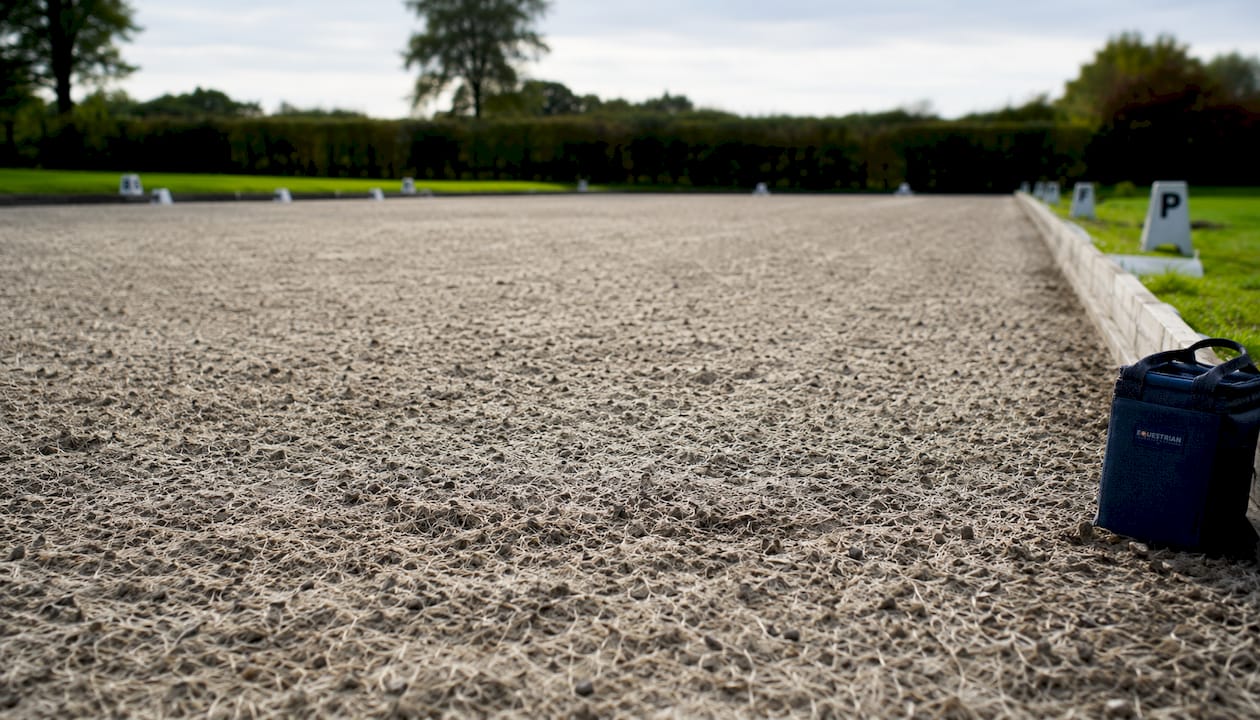
Fibre systems, typically comprising polypropylene or polyester fibres mixed with sand, are the dominant choice for all-weather arenas across the UK. The fibres bind sand particles together, reducing compaction and maintaining cushioning even after heavy use. They also retain moisture more effectively than plain sand, cutting watering frequency and dust risk. For barefoot horses, fibre surfaces offer a forgiving texture that supports natural hoof function without the abrasiveness of angular sand alone. Equestrian Surface Solutions offers a standalone fibre surface designed to perform year-round in British conditions.
Rubber chippings
Recycled rubber chippings add elasticity and shock absorption to arena surfaces, making them particularly well suited to rehabilitation work, young horses in early training, and horses with a history of joint or hoof problems. Rubber does not compact in the same way sand does, and it drains freely, which is a practical advantage through the British winter. The surface tends to be forgiving underfoot without being excessively deep, supporting natural break-over without placing undue strain on the flexor tendons. For a surface comparison across fibre, rubber, and woodchip, Equestrian Surface Solutions provides a dedicated guide.
Woodchip footing
Woodchip is the most accessible low-cost option and suits temporary or low-traffic arenas. It provides reasonable cushioning when fresh but decomposes progressively, breaking down into fine organic particles that compact readily and contribute to dust. As it ages, woodchip loses its structural integrity and can create uneven, unpredictable footing. For horses in regular work, woodchip requires frequent replacement and is not recommended as a long-term solution for facilities prioritising hoof health.
How to maintain your arena surface to protect hoof health
Maintenance is where most arena surface problems originate. A well-chosen material installed on a sound base will still fail if the maintenance routine does not match the intensity of use.
- Harrow regularly and proportionally to use. A busy livery yard working multiple horses daily needs harrowing after every session or at minimum every morning. Compaction drastically reduces shock absorption, and frequent harrowing is the primary defence against it. Both superficial and deep harrowing are needed: superficial passes redistribute the top layer, while periodic deep harrowing breaks up compacted zones beneath the surface.
- Manage moisture actively. Water the surface before it dries out, not after. In the UK, outdoor arenas may need no additional watering from October through April, but indoor arenas require consistent moisture management year-round. Under-watered surfaces become dusty and loose; over-watered surfaces become heavy and sticky.
- Monitor traffic patterns. The track along the arena rail, the approach and landing zones near jumps, and the diagonal lines used in flatwork all compact faster than the rest of the surface. Rotate your riding patterns deliberately to distribute wear, and pay extra attention to these zones during harrowing.
- Check the base. Foundation quality critically impacts surface uniformity and injury prevention. A properly graded limestone or asphalt base with a slight incline for drainage prevents water from pooling beneath the surface and creating localised hard spots. If your surface is developing persistent wet patches or hard zones, the base may need attention before the footing itself is addressed.
- Top up footing material before it runs thin. Footing that has been displaced or broken down below its working depth exposes horses to the base, which causes permanent ruts and dramatically increases concussive injury risk.
- Adjust for UK seasons. Autumn and winter bring sustained wet conditions that can waterlog outdoor arenas and alter the mechanical properties of sand-based surfaces significantly. Spring often reveals compaction that built up under winter traffic. A seasonal maintenance review, ideally in September and again in March, helps you stay ahead of surface deterioration.
For a full maintenance schedule tailored to your surface type, the Equestrian Surface Solutions arena maintenance guide covers monitoring routines, harrowing protocols, and when to call in professional support.
UK expert insights: what veterinary and biomechanical research tells us
The veterinary evidence on arena surfaces and hoof health points consistently in one direction: soft tissue injuries accumulate quietly, long before a horse shows obvious lameness. Veterinary experts emphasise that tendon and ligament damage often builds through daily training on subtly altered or poorly maintained footing, not through single traumatic events. By the time a horse is visibly lame, the underlying micro-damage may have been accumulating for weeks or months.
Biomechanical research adds an important nuance: surface properties are strain-dependent. A surface does not behave the same way for every horse. A heavier horse at canter will compress a sand-fibre surface more deeply than a lighter horse at trot, effectively creating a different footing experience from the same material. This means surface selection is genuinely horse-specific, and a surface that works well for one animal in your yard may not suit another.
The question of surface variety is also worth addressing directly. Horses trained exclusively on uniform synthetic surfaces can develop decreased adaptability, increasing their injury risk when they compete on varied grounds. Regularly rotating horses between surfaces with different mechanical properties builds musculoskeletal strength and proprioception. This does not mean avoiding quality arena surfaces; it means supplementing arena work with hacking, field turnout, and occasional work on different ground types to maintain the horse’s physical resilience.
Foundation quality is another area where UK facilities frequently underinvest. Mixing inconsistent base materials creates uneven drainage, localised hard spots, and concussive injury risks as the hoof transitions between surface zones. A properly graded base with a slight incline for water run-off is not a luxury; it is the structural prerequisite for any surface to perform consistently over time.
Pro Tip: If your horse is consistently stiff on one rein or shows asymmetric wear on its shoes, check for surface unevenness before assuming a musculoskeletal cause. Uneven footing is a common and overlooked contributor to one-sided tension.
Equestrian Surface Solutions works with UK facility managers and private owners to match materials to the specific demands of their site, discipline, and horse population. The team’s knowledge of British weather patterns, soil types, and drainage challenges means the advice you receive is grounded in real UK conditions, not generic guidance.
Equestrian Surface Solutions: materials built for UK hoof health
Getting the surface right from the start saves money, protects horses, and gives you confidence every time you ride. Equestrian Surface Solutions supplies the full range of materials needed for arena construction and refurbishment across the UK, from premium silica sand and fibre blends to rubber chippings, drainage membranes, and surface top-up products.
Whether you are building a new arena, refreshing a tired surface, or troubleshooting a specific hoof health concern, Equestrian Surface Solutions can help you identify the right material for your discipline, budget, and horses. The team understands that a dressage surface, a jumping arena, and a rehabilitation track each place different demands on footing, and they stock materials to meet all three. For facilities managing barefoot horses or young horses in early training, the advice on rubber and fibre options is particularly practical.
Visit the arena surface advice hub for detailed guidance, or request a quote to get a recommendation tailored to your specific site and requirements.
Key takeaways
The surface your horse works on shapes hoof health, tendon integrity, and long-term soundness more directly than almost any other environmental factor.
| Point | Details |
|---|---|
| Surface choice is discipline-specific | Jumping requires higher shear strength; flatwork benefits from slightly lower resistance to support collected movement. |
| Compaction is the primary maintenance threat | Regular harrowing and moisture management are essential to preserve shock absorption in sand and fibre surfaces. |
| Soft tissue damage accumulates silently | Tendon and ligament micro-damage builds through subtle surface changes long before visible lameness appears. |
| Foundation quality underpins everything | A properly graded limestone or asphalt base with drainage incline is the prerequisite for consistent surface performance. |
| Equestrian Surface Solutions | Supplies UK-specific silica sand, fibre blends, rubber chippings, and membranes to match surface to discipline and horse. |
FAQ
What is the best surface for a horse arena in the UK?
No single surface suits every situation, but medium to coarse washed silica sand, often blended with fibre or rubber, performs well across most UK disciplines and weather conditions. The right choice depends on your discipline, horse type, and maintenance capacity.
How does arena footing affect horse hoof health?
Arena footing directly influences the concussive forces, shear loads, and break-over resistance experienced by the hoof with every stride. Poor footing, whether too hard, too deep, or inconsistent, causes cumulative micro-damage to tendons, ligaments, and hoof structures over time.
How do you maintain a horse arena surface?
Harrow regularly and in proportion to use intensity, manage moisture actively to prevent dust and compaction, monitor high-traffic zones for wear, and carry out a seasonal review in autumn and spring to address surface deterioration before it affects horse soundness.
How much does an arena surface cost in the UK?
Arena surface costs vary considerably depending on material type, arena size, and whether you are building new or refurbishing. Equestrian Surface Solutions provides a cost and planning guide with current UK pricing to help you budget accurately.
Are rubber chippings suitable for barefoot horses?
Rubber chippings are one of the most suitable surfaces for barefoot horses. They provide good shock absorption without the abrasiveness of angular sand, drain freely through British winters, and support natural hoof function without placing excessive strain on unshod feet.
