
When you spot surface wear patterns in your training arena, act in this order: restrict use in any area where the footing is unsafe, apply short-term corrections your yard team can complete within a day, then decide whether the problem needs a specialist. Most early wear is correctable without professional help. Persistent, rapidly recurring, or widespread deterioration usually signals a base or drainage issue that routine maintenance cannot fix.
Immediate action checklist:
- High risk (restrict now): Exposed base material, ruts deeper than 50 mm, standing water that persists more than 24 hours after rain, or slick polished patches. Fence off the affected zone and limit use to safe areas until repairs are made.
- Medium risk (correct within a week): Rail tracks, corrugation, localised compaction, or divots covering less than 20% of the surface. Adjust harrowing depth, redistribute material, and check moisture levels.
- Low risk (monitor and schedule): Slight unevenness along frequently used lines, minor surface displacement around the gate, or early dust formation. Log it, photograph it, and address it at the next scheduled maintenance session.
Table of Contents
- How do you spot common wear patterns in training arenas?
- Mapping causes to symptoms: why each wear pattern appears
- Why does uneven footing affect horse safety and performance?
- What routine actions correct early wear before it worsens?
- When does wear signal base or drainage failure?
- How do you prevent wear from recurring?
- A ready-to-use maintenance schedule for your arena
- What does the research say about surfaces, machines, and consistency?
- Key takeaways
- The mistake most arena owners make, and how to avoid it
- How Equestrian Surface Solutions can help you restore consistent footing
- Authoritative sources and further reading
- FAQ
How do you spot common wear patterns in training arenas?
Surface wear patterns in training arenas follow predictable shapes. Knowing what to look for means you can diagnose the problem before it reaches the base.
The six patterns to check for:
- Rail tracks: Parallel grooves running along the long sides of the arena, typically noticeably deep enough to feel a firm ridge on either side of a softer channel. Run your hand along the track; if you feel a firm ridge on either side of a softer channel, the footing has migrated inward.
- Ruts: Localised depressions, often at corners, transitions, or where horses repeatedly halt. Press a flat board across the rut; a noticeable gap indicates moderate severity.
- Corrugation (wash boarding): Rhythmic ridges across the surface, usually perpendicular to the direction of travel. These are a classic sign of harrowing at the wrong tine depth or speed.
- Divots and bare patches: Irregular holes or areas where the footing has been displaced entirely, exposing the base. Any bare patch larger than a dinner plate warrants immediate attention.
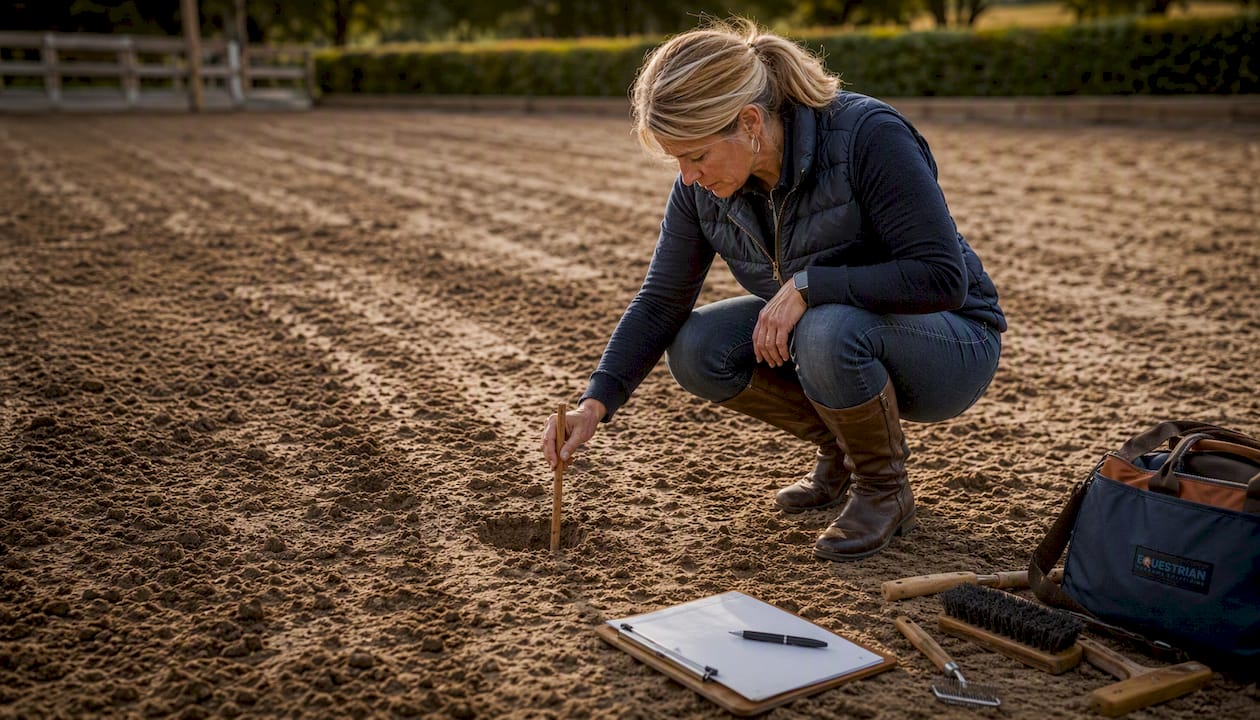
- Compaction: The surface feels firm underfoot even after harrowing. Push a pencil or thin dowel into the surface; if it meets resistance within 30 mm, compaction is present.
- Slick or polished patches: A shiny, hard surface, often near the centre or along frequently schooled lines. These form when fine particles bind under repeated loading without adequate moisture.
Severity scale: Minor = pattern visible but shallow and no base exposure. Moderate = measurable depth, recurring after harrowing, covering a defined zone. Severe = base exposed, pattern persists within 24 hours of repair, or covers more than a third of the arena.
For photographic records, photograph each pattern from directly above and from a low angle to show depth. Mark a consistent reference point (e.g. a fence post) so images are comparable over time. Date every photograph and store them alongside your maintenance log.
Mapping causes to symptoms: why each wear pattern appears
Every wear pattern has a root cause. Matching the symptom to the cause saves you from treating the surface when the real problem is a management habit or a base defect.
- Rail tracks form when riders consistently work on the outside track without varying their path. The footing migrates inward, leaving a compacted channel at the rail.
- Ruts at corners and transitions result from repeated loading in the same spot, particularly in dressage schooling where transitions are practised at the same letter repeatedly.
- Corrugation is almost always a harrowing problem: tines set too shallow skim the surface without redistributing material, while tines set too deep dredge the base and create ridges.
- Divots and bare patches typically appear where jumping efforts concentrate, where horses are stopped repeatedly, or where lunging circles overlap without rotation.
- Compaction builds up in high-traffic zones when the surface is harrowed without adequate moisture. Dry footing does not redistribute; it simply compresses further.
- Slick patches develop when fines accumulate through particle breakdown. Over 5% fines passing a 200-sieve generally indicates increased dust risk and a likely need to amend or replace the footing.
Environmental factors compound all of these. Wet–dry cycling causes the surface to expand and contract, loosening the bond between footing and base. Exposed outdoor arenas are particularly vulnerable in autumn and spring when rainfall is irregular.
Pro Tip: Inspect your arena the morning after a wet–dry cycle, before any harrowing. The surface will reveal its true condition: soft spots indicate drainage problems, hard crusted areas suggest compaction, and any visible base material points to a depth deficit. Photograph the findings before you disturb the surface.
Why does uneven footing affect horse safety and performance?
Inconsistent footing increases injury risk and reduces performance consistency. That is the short answer, and the biomechanical evidence supports it clearly.
The FEI white paper on equine arena surfaces describes three force phases at the hoof during every stride: impact, support, and push-off. When the surface varies from one stride to the next, the forces through the limb change unpredictably. The horse cannot adapt its musculoskeletal loading fast enough, which increases the risk of soft-tissue injury, particularly to tendons and ligaments.
Consider a practical example. A horse lunging on a circle where the footing is 80 mm deep on one arc and 30 mm deep on the opposite arc experiences a significant change in cushioning and grip within a single revolution. The deeper side absorbs more energy on impact; the shallower side returns more force on push-off. Over a 20-minute session, that asymmetry accumulates into real loading stress.
Key risks from worn or uneven surfaces:
- Altered hoof–surface interaction during push-off, increasing tendon strain
- Reduced grip on slick patches, raising the risk of slipping and joint injury
- Compensatory movement patterns that develop when horses repeatedly adjust to inconsistent footing
- Reduced training quality, as horses cannot perform consistently when the surface changes underfoot
FEI guidance also notes that horses conditioned on varied surfaces reduce their injury risk compared with animals trained exclusively on one surface type. Rotating training locations, where possible, is a genuine welfare measure, not just a management convenience.
What routine actions correct early wear before it worsens?
Three actions resolve most early-stage wear: restrict use in the affected zone, redistribute the footing, and control moisture. Everything else builds on those three.
- Restrict and protect. Temporarily fence off or cone off the worst-affected area. This stops the pattern deepening while you prepare to correct it, and it prevents horses from adapting their movement to the uneven surface.
- Redistribute by harrowing. Set tine depth to reach the base without penetrating it. A depth check with a ruler before you start confirms the correct setting. Vary your drag pattern: if you always harrow in the same direction, you will recreate the same ridges. Alternate diagonal, longitudinal, and circular patterns weekly.
- Control moisture. Apply water evenly before harrowing, not after. The goal is a surface that holds its shape when pressed into a ball but does not stick to your hand. Dry footing does not redistribute; wet footing smears. Moisture is the single largest variable affecting surface consistency in sand arenas.
Maintenance frequencies by use level:
- Light use (under 4 hours per day): Harrow every 2–3 days, water as needed to maintain cohesion, monthly depth check.
- Moderate use (4–8 hours per day): Harrow daily, water before each session in dry conditions, fortnightly depth check.
- Heavy use (over 8 hours per day or multiple disciplines): Harrow after every session, water twice daily in dry weather, weekly depth check.
For targeted patching, match the top-up material precisely to your existing surface. Adding premium silica sand to a fibre-blend arena, or rubber chippings to a plain sand surface, creates inconsistency in cushioning and grip. If you are unsure of your current specification, take a small sample and compare particle size and colour before ordering.
Pro Tip: On sand-with-rubber surfaces, maintenance machines redistribute crumb rubber and increase superficial firmness after each session. If your surface feels noticeably firmer after harrowing, reduce roller pressure or switch to a lighter drag pass to avoid over-compacting the rubber layer.
When does wear signal base or drainage failure?
Some problems cannot be solved with a harrow and a watering can. Recognising the red flags early saves you from months of repeated surface repairs that never hold.
Red flags that indicate base or drainage failure:
- Standing water that persists for an extended period after rainfall, or water that appears repeatedly in the same spot after wet periods
- Bare patches or ruts that return within 48 hours of repair
- Widespread unevenness that spans multiple use zones, not just one discipline’s track
- Footing that feels soft and unstable even when dry, suggesting the base has lost its structural integrity
- Visible base material in more than one location simultaneously
When you see two or more of these together, commission a professional survey rather than continuing surface-level repairs. A sound base is essential because loose footing must knit to the compacted base; once that bond is broken by base deterioration, no amount of top-up material will restore consistent performance.
What a professional survey should include:
- Drainage mapping: flow paths, outlet condition, and any blocked or collapsed drainage runs
- Base integrity testing: probing for soft spots, settlement, or contamination
- Particle and fines analysis of the existing footing
- Written recommendations with prioritised repair options and indicative costs
“Surface failures often begin as maintenance lapses that become base problems if not addressed early; photographic records and routine logging reduce dispute and support funding for repairs.”
— Equestrian Surface Solutions arena maintenance guidance
In terms of UK costs, minor drainage repairs (clearing outlets, re-grading a small section) typically range from a few hundred to low thousands of pounds. Full base reinstatement for a standard 20 m × 40 m arena is a more significant investment; obtain at least two written quotes and ask each contractor to specify what base testing they will carry out before work begins. For further guidance on arena surface replacement triggers, review the warning signs before committing to a full rebuild.
While waiting for works, limit use to the safest sections, use temporary post-and-rail fencing to define safe zones, and continue daily harrowing of the usable area to maintain what footing remains.
How do you prevent wear from recurring?
Prevention is cheaper than repair. A simple rotation programme and a few layout adjustments will extend the life of your surface significantly.
Discipline-specific adjustments:
- Dressage: Vary transition points along the long side rather than always using the same letter. Incorporate centreline and three-quarter line work to spread loading across the full width.
- Jumping: Rotate approach lines and landing zones weekly. Move jump wings at least a metre from their previous position to prevent localised base loading.
- General schooling: Vary diagonals, incorporate lateral work, and alternate rein regularly. Riders who always school on the left rein create asymmetric wear within weeks.
- Lunging: If you lunge in the main arena, rotate the circle centre at least 5 m between sessions. Better still, designate a separate lunge area or use a lunge ring to protect the main surface.
Layout tweaks that reduce wear concentration:
- Mark warm-up lanes with ground poles or cones to distribute traffic across the full arena width
- Use signage at the gate to remind riders to vary their warm-up track
- Define a dedicated warm-up zone at one end of the arena so the working area receives more even use
A simple preventative rota:
- Daily: Harrow after the last session, check and adjust moisture, remove manure.
- Weekly: Deep harrow with varied pattern, rake edges to return displaced footing, check depth at five points.
- Monthly: Full depth survey, photograph all wear zones, review rotation patterns and adjust if new tracks are forming.
A ready-to-use maintenance schedule for your arena
Consistent maintenance is what separates a surface that lasts a decade from one that needs rebuilding in three years. The schedule below is designed to be copied directly into a yard management log.
Weekly and monthly checklist:
- Remove all jumps, poles, and equipment before harrowing
- Check tine depth with a ruler before each drag session
- Water evenly before harrowing in dry conditions
- Rake edges and corners to return displaced footing to the track
- Remove manure promptly, particularly on fibre-blend surfaces where organic breakdown accelerates particle degradation
- Inspect drainage outlets monthly for blockage or collapse
- Check all harrowing and levelling equipment for worn tines or damaged blades
Simple depth and firmness checks without specialist tools:
Use a marked wooden dowel or metre rod. Measure at five consistent points: rail (long side centre), quarter line, centre, diagonal intersection, and near the gate. Record the depth in millimetres at each point. A healthy sand-fibre surface typically reads 75–100 mm; shallower readings at the rail or gate indicate migration and the need for top-up material.
For firmness, the ball-in-hand test is reliable: press a handful of surface material into a ball. If it holds shape without crumbling, moisture is adequate. If it crumbles immediately, water before harrowing. If it sticks and smears, the surface is too wet to work.
| Task | Frequency | Who |
|---|---|---|
| Harrow and level | After every session (heavy use) / every 2–3 days (light use) | Yard staff |
| Moisture check and watering | Before each session in dry weather | Yard staff |
| Edge raking | Weekly | Yard staff |
| Depth check (5 points) | Monthly | Yard manager |
| Photographic record | Monthly | Yard manager |
| Drainage outlet inspection | Monthly | Yard manager |
| Deep harrow (varied pattern) | Monthly | Yard staff |
| Full surface assessment | Annually | Specialist or yard manager |
Log every depth reading and photograph alongside the date and weather conditions. Trends in the data, such as the rail depth dropping by 10 mm each month, tell you far more than a single snapshot, and they provide the evidence base you need if you are commissioning repairs or justifying expenditure to a board or landlord.
What does the research say about surfaces, machines, and consistency?
Consistent, well-maintained surfaces reduce injury risk more reliably than theoretically ideal but inconsistently maintained ones. That finding runs through the FEI guidance, UK-based testing, and academic literature.
The FEI white paper frames the surface as a system in which moisture content is the primary driver of temporal variability for sand arenas. Managing moisture consistently, session to session, does more for surface performance than any single material upgrade.
UK-based testing by the Animal Welfare Foundation examined sand-only (SR), sand-with-fibre (SF), and waxed sand-with-fibre (WSF) arenas. The study found that different maintenance machines produce significantly different effects on surface properties: rolling increased impact firmness and grip on SF surfaces, while harrowing and levelling varied in effect depending on surface type. On sand-with-rubber surfaces, maintenance redistributed crumb rubber and increased impact firmness after each session. These findings matter practically: the machine you use, and how you use it, changes what your surface does underfoot.
“FEI guidance frames the surface as a complex system in which impact, support and push-off phases are altered by inconsistent footing — manage for consistency rather than theoretical perfection.”
— FEI White Paper on Equine Arena Surface Assessment
Fibre and wax additives alter maintenance demands in ways that catch many yard managers off guard. Waxed sand and fibre blends reduce moisture sensitivity in some conditions but interact differently with rollers and harrows. Using a heavy roller on a waxed surface can over-compact the wax coating and reduce permeability, which is the opposite of the intended effect. Always check the maintenance recommendations for your specific surface specification.
For facility managers who need to justify repair expenditure, the World Horse Welfare arena surfaces guidance and the Animal Welfare Foundation quantification study both provide citable evidence that surface wear is a welfare issue, not merely a performance one.
Key takeaways
Consistent maintenance and early intervention are the most cost-effective tools an arena owner has: surface wear patterns are manageable when caught early, but they become expensive base problems when ignored.
| Point | Details |
|---|---|
| Safety triage first | Restrict use in any zone with exposed base, ruts over 50 mm, or persistent standing water before attempting repairs. |
| Match the pattern to the cause | Each wear pattern has a specific cause; corrugation signals harrowing error, rail tracks signal rotation failure, slick patches signal fines accumulation. |
| Moisture drives consistency | Moisture is the primary variable in sand arena performance; water evenly before harrowing, not after, to maintain cohesion. |
| Base failure needs a specialist | Rapid recurrence after repair, widespread unevenness, or persistent standing water indicate base or drainage failure beyond routine maintenance. |
| Equestrian Surface Solutions | Supplies matched top-up materials, specialist sands, fibre blends, and drainage products to restore consistent footing across UK arenas. |
The mistake most arena owners make, and how to avoid it
The single most common error I see is treating surface wear as a cosmetic problem. Yards harrow the visible ridges flat, the arena looks fine for a day or two, and then the same pattern reappears in exactly the same place. The surface is telling you something, and harrowing over it without changing the underlying cause is like painting over damp: it delays the conversation you need to have.
The three mistakes that lead to expensive repairs are predictable. First, harrowing at the wrong tine depth, either too shallow to redistribute material or too deep to dredge the base and introduce fines. Second, ignoring early drainage signals, particularly that persistent soft spot near the gate or the corner that never quite dries out. Third, patching with whatever sand is available rather than matching the particle size and specification of the existing surface. Mismatched top-up material creates a layer boundary that behaves differently under load, accelerating wear at the join.
What actually works is straightforward: a monthly depth check at five consistent points, a varied harrowing pattern, and a photograph log that lets you see trends before they become crises. Yards that adopt this approach typically extend the interval between major repairs considerably. The investment is a marked dowel, a notebook, and 20 minutes a month. For practical examples of how surface failures develop and what corrective works look like, the arena surface failure case studies from Equestrian Surface Solutions are worth reviewing before you commission any repair.
How Equestrian Surface Solutions can help you restore consistent footing
Worn surfaces and recurring wear patterns are almost always a materials or maintenance specification problem, and that is exactly what Equestrian Surface Solutions is set up to solve. Rather than replacing an entire surface when targeted top-up or a drainage repair would suffice, the team helps you identify the right material for your existing specification and supplies it directly, whether that is matched silica sand, a fibre blend, rubber chippings, or a drainage membrane.
What Equestrian Surface Solutions supplies:
- Site-specific material recommendations based on your discipline, use level, and existing surface
- Specialist riding arena sands, fibre blends, and rubber additives for top-up and full refurbishment
- Arena membranes and drainage products for base-level repairs
- Complete self-build arena kits for full replacements
- Guidance on maintenance specifications matched to your surface type
The process starts with a conversation about what you are seeing on your surface, not a hard sell on a full rebuild. If a top-up and adjusted maintenance routine will solve the problem, that is what will be recommended. To get matched material recommendations or request a quote, visit the Equestrian Surface Solutions quote page and describe what you are dealing with.
Authoritative sources and further reading
These are the primary resources to consult when commissioning repairs, briefing contractors, or presenting a safety case to stakeholders.
- FEI White Paper on Equine Arena Surface Assessment: Covers biomechanical force phases, surface consistency measurement, and the role of moisture. Use this when briefing contractors on performance standards or justifying investment.
- FEI Equestrian Surfaces: A Guide: Practical guidance on surface types, discipline-specific requirements, and training variation for welfare. Useful for facility planning and rider briefings.
- Animal Welfare Foundation: Quantification of Sand-Based Arena Surface Characteristics: UK-based testing of machine effects on SR, SF, and WSF surfaces. Cite this when specifying maintenance equipment or justifying a change in harrowing regime.
- University of Kentucky Cooperative Extension: Riding Arena Maintenance: Detailed practical guidance on dragging patterns, depth checks, and treatments. Useful for yard staff training and maintenance protocol development.
- Penn State Extension: Riding Arena Footing Material Selection and Management: Covers particle size, fines content, and discipline-specific material selection. Consult when specifying top-up material or assessing dust and compaction problems.
- World Horse Welfare: Arena Surfaces Guidance: UK-focused welfare perspective on surface standards. Useful for presenting a welfare case to landlords, insurers, or competition licensing bodies.
FAQ
What are the most common surface wear patterns in training arenas?
The six most common patterns are rail tracks, ruts, corrugation (wash boarding), divots and bare patches, compaction, and slick or polished patches. Each has a specific cause, from repeated use on the same track to incorrect harrowing depth or inadequate moisture management.
How do I know if wear is a surface problem or a base problem?
If a wear pattern returns within 48 hours of repair, or if you see standing water persisting more than 24 hours after rainfall, the problem is likely in the base or drainage rather than the surface footing. A professional survey with drainage mapping and base integrity testing will confirm this.
How often should I harrow a training arena?
For heavy use (over 8 hours per day), harrow after every session. Moderate use (4–8 hours) requires daily harrowing, and light use (under 4 hours) every 2–3 days. Vary the drag pattern each time to avoid recreating the same ridges.
What top-up material should I use to patch worn areas?
Match the particle size, shape, and specification of your existing surface as closely as possible. Adding mismatched sand or rubber to an established surface creates a layer boundary that wears unevenly. Equestrian Surface Solutions can advise on matched materials based on your current specification.
Does moisture really matter that much for arena maintenance?
Yes. The FEI white paper identifies moisture as the single largest variable affecting surface consistency in sand arenas. Water applied evenly before harrowing, not after, maintains cohesion and allows the footing to redistribute correctly rather than simply compressing under the drag.
