

A performance surface checklist is a structured assessment tool that horse trainers use to evaluate arena footing against five criteria recognised by FEI-aligned standards: impact firmness, cushioning, responsiveness, grip, and uniformity. Poor footing is one of the leading causes of soft-tissue injury in competition horses. A systematic equestrian performance checklist removes guesswork from surface selection and maintenance, giving trainers a repeatable framework for every arena they manage or commission.
1. The performance surface checklist: five criteria every trainer must assess
FEI-aligned standards define five non-negotiable surface parameters for safe, effective footing. Each one directly affects musculoskeletal health and training outcomes.
- Impact firmness. The surface must absorb concussion without transmitting excessive force to joints. Hard ground increases concussion injury risk; overly compacted sand with no additive is a common culprit.
- Cushioning. The footing must support the horse’s weight on landing without collapsing. Footing depth above 3 inches significantly increases suspensory ligament strain, so deeper is not safer.
- Responsiveness. A well-specified surface returns energy to the horse’s stride. Flat, dead footing with no fibre or rubber content reduces this quality noticeably.
- Grip. Traction must be sufficient for confident movement without locking the hoof. Excess grip increases rotational joint strain, particularly in lateral work.
- Uniformity. Consistent firmness and depth across the entire arena is the most frequently neglected criterion. Corners and gate areas deteriorate faster and require targeted attention during every maintenance session.
Arena design aims not for the softest or hardest surface but for a balanced combination of all five characteristics to protect musculoskeletal health. Maximising any single criterion at the expense of others creates a different set of problems.
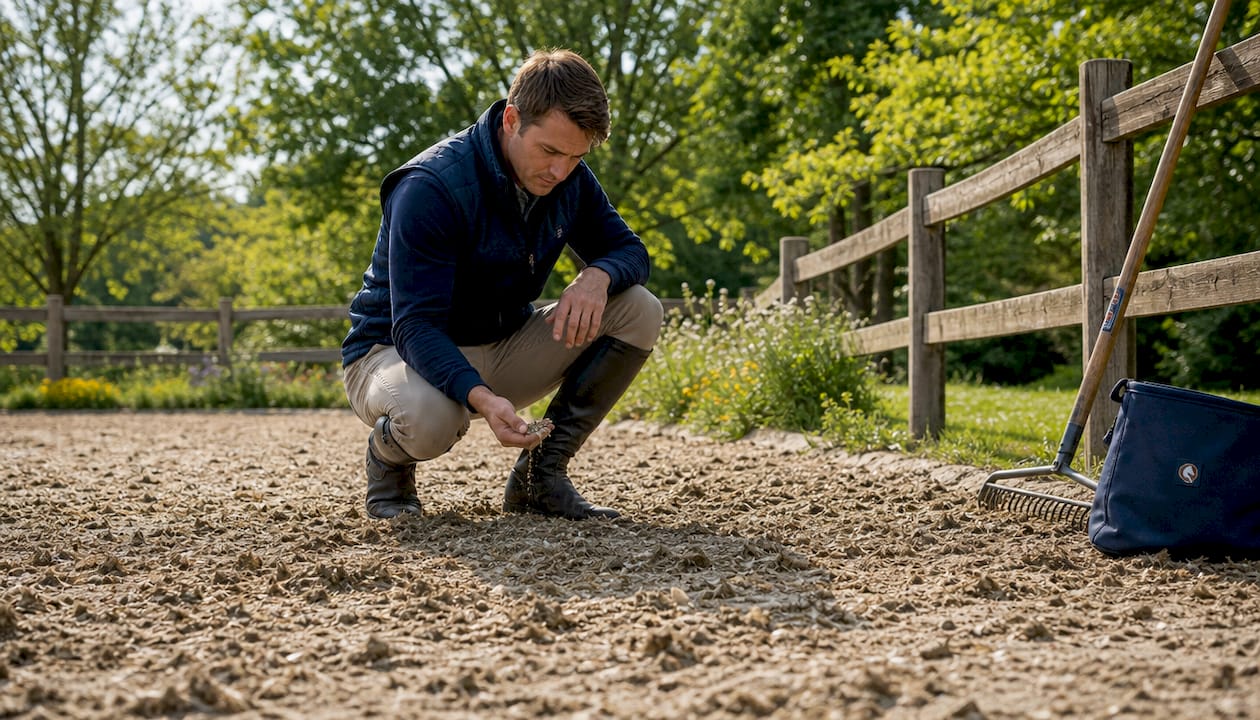
Pro Tip: Walk the full perimeter of your arena before each training session. Uneven depth in corners and near gates is the earliest visible sign that your maintenance schedule needs adjusting.
2. Recommended materials and installation depths
Material choice determines how well a surface meets the five criteria above. The table below summarises the most common options used in UK arenas.
| Material | Key property | Typical use |
|---|---|---|
| Washed silica sand | Drainage, stability, dust control | Base layer and standalone surface |
| Synthetic fibre blend | Cushioning, responsiveness, cohesion | Mixed with sand for all-weather arenas |
| Rubber crumb | Shock absorption, energy return | Additive or standalone surface |
| Engineered fibre/sand blend | Balanced performance across all five criteria | Competition and high-use training arenas |
Sub-angular silica sand grains provide the best interlock and compression balance, making them the preferred choice for arena footing. Round grains cause instability; angular grains create rigidity. High silica content above 90% contributes to resilience, dust control, and long-term durability.
Standard private arenas use 2 to 2.5 inches of washed silica sand mixed with 5–10% synthetic fibres, laid over a 2–4 inch compacted stone-dust base. This specification lasts 7–10 years with proper maintenance. The quality silica sand you select at installation determines how well every other additive performs above it.
Neglecting the geotextile separator fabric between the base and subgrade leads to contamination and expensive repairs within 2–5 years. No top-layer additive can compensate for a compromised base.
Pro Tip: When specifying a new arena, always confirm the grain shape of your sand with the supplier before ordering. Ask specifically for sub-angular, washed silica sand with a high silica content.
3. Essential maintenance practices to preserve surface quality
Routine maintenance is as important as material choice in preserving footing performance. A neglected waxed surface performs worse than a well-maintained basic sand surface. That finding should recalibrate how trainers allocate their maintenance budget.
Key maintenance checks for your horse training facility checklist:
- Harrowing frequency. Harrow at least once per week for arenas in regular use. High-traffic arenas may require harrowing after every session to restore depth uniformity.
- Watering. Water management prevents dust in dry conditions and surface compaction in wet ones. Sand grain shape and material composition affect water retention more than moisture alone. Rubber crumb and geotextile additives reduce watering frequency.
- Visual inspection cues. Bald patches indicate fibre or rubber migration. Puddles signal drainage failure or surface compaction. Dust plumes during work confirm the surface is too dry and the moisture balance needs correcting.
- Depth variance checks. Use a depth gauge or a simple marked rod at multiple points across the arena monthly. Depth variance of more than half an inch between zones requires immediate levelling.
- Top-up intervals. Plan a surface top-up every 2–3 years for high-use arenas. Schedule a full arena surface replacement assessment at the 7-year mark for sand and fibre installations.
4. Site-specific considerations: adapting your checklist by arena type and climate
No two arenas share identical conditions. Your riding arena surface guide must account for site variables before specifying materials or maintenance schedules.
- Drainage design. Poor drainage leads to puddling and surface deterioration in wet climates. Install perimeter drains and a correctly graded sub-base before laying any top material. Drainage design is not optional in the UK climate.
- Dust control in dry conditions. Outdoor arenas in exposed, dry locations require either a watering system or a dust-suppressing additive such as rubber crumb or a wax-coated fibre blend.
- Indoor versus outdoor arenas. Indoor arenas retain moisture more consistently, reducing watering demands. Outdoor arenas face UV degradation of synthetic fibres and require more frequent top-ups.
- Surface crowning and grading. A correctly crowned surface sheds water to perimeter drains rather than pooling in the centre. Proper grading and compaction of the base is the single most critical factor influencing surface longevity.
- Local ground bearing capacity. Soft or clay-heavy subgrades require additional sub-base depth or ground stabilisation before construction. Skipping this step causes uneven settlement and premature surface failure. Review common arena surface failures to understand how subgrade problems present over time.
Key takeaways
A correctly specified and consistently maintained arena surface, built on a stable sub-base, is the single most effective way to protect horse welfare and sustain training performance.
| Point | Details |
|---|---|
| Five criteria define performance | Assess impact firmness, cushioning, responsiveness, grip, and uniformity at every evaluation. |
| Depth is a safety parameter | Keep footing between 2 and 3 inches; exceeding 3 inches raises suspensory ligament injury risk. |
| Base quality determines longevity | No top-layer additive compensates for a poorly graded or contaminated sub-base. |
| Maintenance outweighs material cost | Weekly harrowing and correct watering preserve surface quality more reliably than premium materials alone. |
| Site variables require a tailored checklist | Drainage design, climate, and arena type each alter material choice and maintenance frequency. |
What I’ve learned from applying this checklist in practice
The most common mistake I see trainers make is treating surface selection as a one-time decision. They invest in quality materials, then assume the job is done. The checklist only delivers value if you use it repeatedly, not just at installation.
The second pitfall is chasing softness. Trainers who have experienced a horse injury on hard ground often overcorrect by deepening the surface. Footing above 3 inches does not protect horses. It strains them differently. The goal is balance across all five criteria, not maximum cushioning.
Base preparation is where most budget decisions go wrong. I have seen arenas with premium fibre blends fail within three years because the sub-base was inadequately compacted or the geotextile membrane was omitted. Spending more on the surface and less on the base is a false economy every time.
Use this checklist before you commission a new arena, when you take over management of an existing facility, and at least twice a year as a scheduled assessment. The trainers who get the best results from their surfaces are the ones who treat footing as an ongoing discipline, not a fixed asset.
— Stacey
Surface materials and expert guidance from Equestrian Surface Solutions
Equestrian Surface Solutions supplies specialist arena materials across the UK, from washed silica sands and synthetic fibre blends to rubber additives and drainage membranes. Every product is selected to meet the five performance criteria this checklist is built around.
Whether you are building a new arena from scratch or refurbishing an existing surface, the competition arena specification guide walks you through material selection, depth specifications, and base requirements in detail. For trainers who want a cost-effective all-weather solution, the standalone fibre range delivers consistent performance without the premium price of a full engineered blend. Contact Equestrian Surface Solutions directly for a bespoke material recommendation matched to your discipline, budget, and site conditions.
FAQ
What are the five key criteria in a performance surface checklist?
The five criteria are impact firmness, cushioning, responsiveness, grip, and uniformity. FEI-aligned standards require all five to be assessed together, as optimising one at the expense of another increases injury risk.
What is the correct depth for arena footing?
The recommended depth is 2–3 inches for most disciplines. Depth above 3 inches significantly increases suspensory ligament strain and is not a safer option.
How often should I harrow my arena?
Harrow at least once per week for arenas in regular use. Surface uniformity deteriorates fastest in corners and gate areas, so target those zones first.
What is the best sand for equestrian arena footing?
Sub-angular, washed silica sand with a high silica content above 90% is the preferred choice. Sub-angular grain shape provides the best interlock and compression balance for stable, safe footing.
Does an indoor arena need less maintenance than an outdoor one?
Indoor arenas retain moisture more consistently and face less UV degradation, which reduces some maintenance demands. However, harrowing frequency and depth checks remain equally important regardless of arena type.
