
Arena surfaces need topping up to maintain the correct depth that protects horses from concussion, preserves consistent footing, and keeps your arena performing safely year-round. The industry standard for a sand-only surface is 75–100mm after compaction, and once depth drops below this, cushioning fails and injury risk rises. Every arena loses material through abrasion, displacement, and compaction under hoof traffic. Understanding why arena surfaces need topping up is the first step to protecting both your horse and your investment.
Why arena surfaces lose depth and when to act
Arena surfaces thin through three distinct mechanisms: abrasion, displacement, and compaction. Abrasion grinds sand particles smaller over time, reducing their structural contribution. Displacement pushes material from high-traffic zones toward the centre or against the boards. Compaction locks particles together, collapsing the air pockets that provide cushioning.
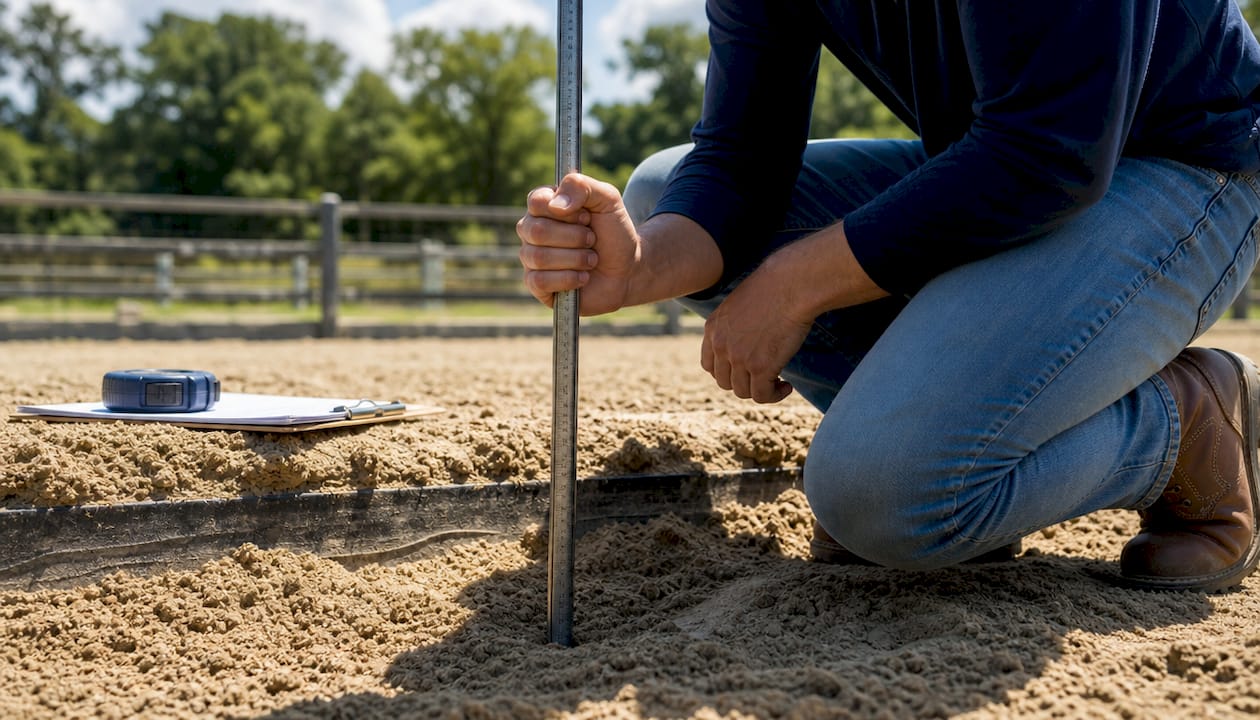
Surfaces thin unevenly, with rails and corners losing depth significantly faster than the centre. This means a single depth measurement taken in the middle of your arena will mislead you. You need to sample at least five or six locations, including both corners and the track, to build an accurate picture.
Knowing when to act is straightforward once you measure regularly. Busy riding schools should assess topping needs every 1–3 years, depending on usage intensity. Private yards with lighter traffic can extend that interval, but should still check annually. Common signs that a top-up is overdue include:
- Visible unevenness or hollows along the track
- Hard, compacted patches that do not respond to harrowing
- Dust clouds rising during dry weather, indicating insufficient depth and moisture retention
- Footing that feels inconsistent or slippery underfoot
Pro Tip: Use a metal rod or depth gauge at multiple points around the arena. Push it to the base membrane and measure the depth of loose material above it. Record each reading so you can track wear patterns over time.
How topping up protects horse welfare and performance
A depleted surface loses its ability to absorb concussion, and the consequences for horses are direct. Poor surface conditions increase fatigue and injury risk when horses work repeatedly on ground that offers no give. Tendons, joints, and hooves absorb forces that the surface should be managing. This is not a theoretical risk. It is the reason surface depth specification exists as an industry standard.
Sufficient depth also maintains grip. A surface that is too thin becomes hard and slick, while one that is too deep becomes unstable. Both extremes undermine horse confidence and rider control. Consistent footing allows horses to move freely and predictably, which matters as much in a schooling session as it does in competition.
Moisture management is directly tied to surface depth. A thicker layer retains moisture more evenly, reducing dust in dry conditions and resisting waterlogging in wet weather. Light, consistent watering outperforms deep infrequent soaking, which causes uneven compaction and inconsistent footing. Depth supports that watering routine by giving moisture somewhere to distribute and hold.
The risks of neglecting a top-up compound quickly:
- Reduced shock absorption leads to increased concussion on horse limbs
- Thin patches create unpredictable footing that unsettles horses mid-movement
- Compacted areas shed water rather than absorbing it, creating wet and dry zones
- Surface damage accelerates, shortening the overall lifespan of the arena
What materials are used for arena topping?
Silica sand is the standard material for topping up most UK arenas. It offers consistent grain size, good drainage, and the angular particle shape that locks together to provide stable footing. When selecting a top-up material, grain size and angularity matter as much as volume. Rounded grains shift too freely; overly fine grains compact and seal the surface.
Matching your top-up material to the existing surface is critical. Introducing a different sand grade or a different material type disrupts the surface structure and can create layers that behave inconsistently under load. If your arena uses a silica sand and fibre blend, the top-up must replicate that blend in the correct ratio.
Synthetic fibre additives improve resilience and moisture retention but require specific maintenance to avoid uneven distribution. Fibres need replenishment alongside the sand, not as an afterthought. Wax-coated sands reduce dust and improve moisture retention but carry a higher cost and require compatible maintenance equipment.
Quantity planning is straightforward once you have your depth measurements. A standard top-up of 25–50mm depth requires 40–80 tonnes of silica sand for a 20m x 40m arena. Deeper depletion requires more material, which is why accurate measurement before ordering saves both time and cost.
Pro Tip: Always request a grading certificate from your sand supplier. This confirms particle size distribution and ensures the material meets the specification for your surface type. Equestrian Surface Solutions provides this documentation as standard.
Best practices for topping up and ongoing maintenance
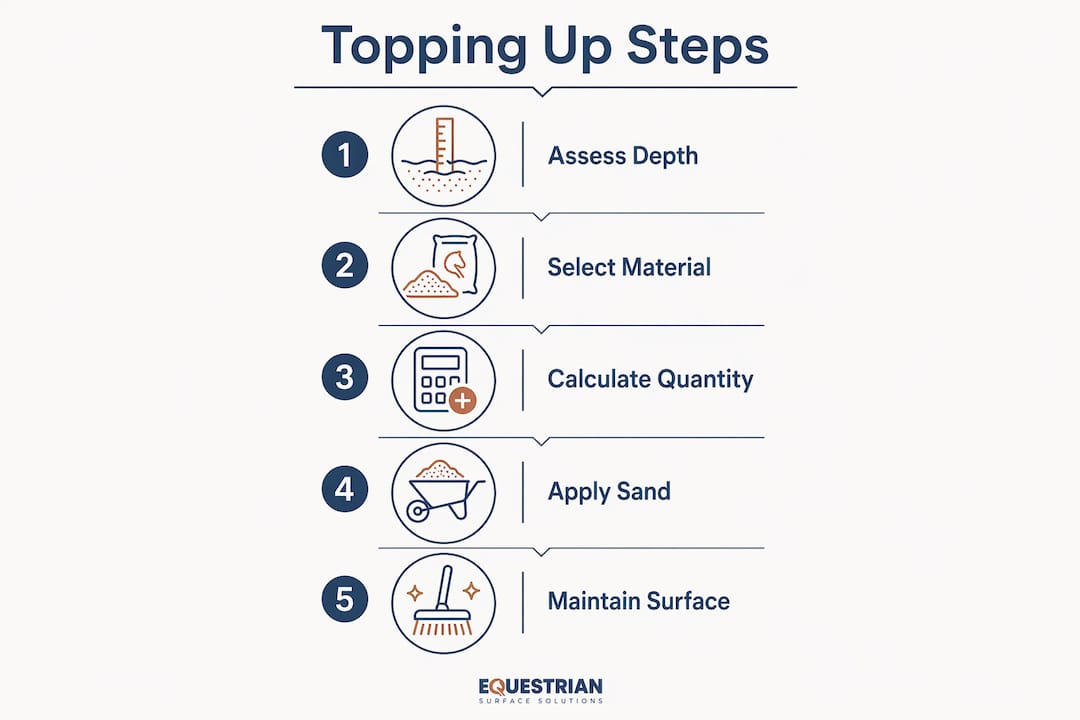
Topping up is not simply a matter of tipping sand onto the arena and harrowing it in. Done correctly, it follows a clear sequence that protects the existing surface structure and integrates the new material evenly.
- Measure depth across multiple points. Record readings at the track, corners, centre, and any visibly worn patches. This determines how much material you need and where to concentrate it.
- Source matched material. Confirm grain size, angularity, and any additive ratios before ordering. Mismatched material creates layering problems that worsen over time.
- Spread evenly and in stages. Avoid dumping large quantities in one location. Spread in thin passes and work the material across the full arena surface.
- Harrow thoroughly after spreading. Multiple harrowing passes in different directions integrate the new material with the existing surface and prevent a visible join between old and new layers.
- Water correctly after topping. Light, even watering after the top-up settles the material and activates moisture retention. Follow the handful test to confirm the surface has reached the right moisture level. An optimally moist surface forms a ball that holds briefly before crumbling.
Ongoing maintenance between top-ups determines how long each top-up lasts. Good maintenance including grading, harrowing, and drainage management extends surface life and improves safety. Regular harrowing prevents compaction from setting in. Consistent watering maintains moisture balance. Checking for common arena surface problems early means you address wear before it becomes structural damage.
Avoid these common pitfalls:
- Over-topping, which creates an unstable, overly deep surface that strains horse tendons
- Using incompatible materials that layer rather than integrate
- Skipping harrowing after spreading, which leaves the new material loose and uneven
- Watering too heavily immediately after topping, which causes the new layer to compact unevenly
Key takeaways
Regular topping up is the single most effective maintenance action for preserving arena surface depth, horse welfare, and consistent footing across all disciplines.
| Point | Details |
|---|---|
| Maintain correct depth | The industry standard is 75–100mm after compaction; below this, cushioning and grip both fail. |
| Check multiple locations | Rails and corners wear fastest, so sample at least five points before calculating top-up quantities. |
| Match your materials | Top-up sand must match the existing surface grade and any fibre or wax additives to avoid layering. |
| Follow the topping sequence | Measure, source, spread in stages, harrow thoroughly, then water lightly to settle the new material. |
| Maintain between top-ups | Regular harrowing and consistent watering extend the life of each top-up and delay the next one. |
What I have learned from watching arenas age
The arenas that deteriorate fastest are not the busiest ones. They are the ones where owners wait for a visible problem before acting. By the time footing looks wrong, the surface has usually been underperforming for months. Horses compensate for inconsistent ground long before riders notice, and that compensation puts strain on joints and tendons that accumulates quietly.
The most practical thing I have seen work is a simple maintenance log. Recording depth measurements, harrowing frequency, and watering routines takes ten minutes a month and tells you exactly when a top-up is due. It removes the guesswork and means you are never caught ordering material in a rush during peak season.
Seasonal planning matters too. Topping up in late summer or early autumn, before the ground hardens and wet weather arrives, gives the new material time to settle and integrate before the arena faces its hardest conditions. Waiting until january to address a surface that has been thinning since spring is the most expensive version of the same job.
Combining topping with arena maintenance best practices is what separates arenas that last a decade from those that need full replacement in five years. Topping is not a standalone fix. It works because it is part of a consistent care routine.
— Stacey
Arena surface materials and expert advice from Equestrian Surface Solutions
Choosing the right top-up material is straightforward when you have the right guidance behind you. Equestrian Surface Solutions supplies premium silica sand and fibre blends graded specifically for UK equestrian arenas, with full documentation so you know exactly what you are laying down.
Whether you manage a private yard or a busy riding school, the team at Equestrian Surface Solutions can help you calculate quantities, confirm material compatibility, and plan a top-up schedule that fits your usage and budget. Explore the full range of arena footing options or request a quote to get started with a surface that performs reliably through every season.
FAQ
What depth should an arena surface be?
The industry standard for a sand-only arena surface is 75–100mm after compaction. Surfaces below this depth lose their cushioning and grip, increasing the risk of injury to horses.
How often should I top up my arena surface?
Busy arenas should be assessed every 1–3 years, with top-ups carried out when depth measurements fall below the recommended specification. Private yards with lighter use can extend this interval but should still check depth annually.
How much sand does a top-up require?
A top-up adding 25–50mm of depth to a standard 20m x 40m arena typically requires 40–80 tonnes of silica sand. The exact quantity depends on how much depth has been lost and where wear is concentrated.
Can I use any sand for topping up?
No. The top-up material must match the grain size, angularity, and any additive content of the existing surface. Mismatched sand creates layers that behave differently under load, leading to uneven footing and accelerated wear.
What is the handful test and why does it matter?
The handful test is a simple moisture check: squeeze a handful of surface material and release it. An optimally moist surface forms a ball that holds briefly before crumbling. This confirms the surface has the right moisture level for safe, consistent footing.
