

What is horse arena levelling and why does it matter?
Horse arena levelling is the process of breaking up compacted footing, redistributing surface materials, and restoring a uniform, safe riding surface across the entire arena floor. It is not simply about making the surface look tidy. Proper levelling prevents dangerous irregularities, maintains consistent shock absorption, and protects both horse and rider from slips, trips, and lameness-inducing uneven ground.
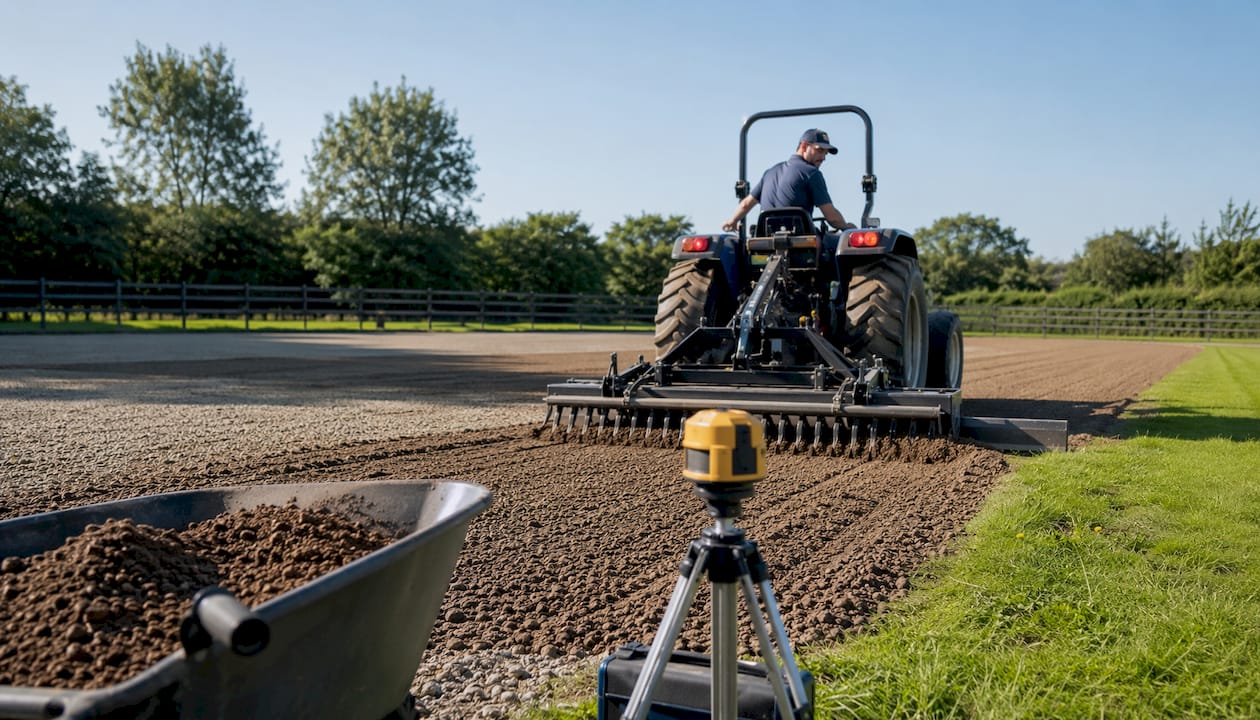
Without regular levelling, high-traffic areas along the track and around jumps shed their footing rapidly. Horses end up working directly off the compacted base layer, which causes permanent ruts that are expensive to repair. The surface may look passable after a quick drag, but the structural integrity underneath tells a different story.
The core benefits of maintaining a levelled arena surface include:
- Consistent shock absorption across the full arena floor, reducing concussion on horses’ legs
- Elimination of compacted patches that create hard, unforgiving ground in high-traffic zones
- Redistribution of footing material from edges back to the centre, preventing trenching
- Reduced dust through better moisture retention in a well-blended surface layer
- Extended lifespan of surface materials including silica sand, fibre blends, and rubber additives
- Safer footing that reduces the risk of slips, falls, and soft-tissue injuries
Standard equipment used in arena levelling includes the ArenaMate® leveller, laser levels for precise grading, and excavators for major site shaping or base correction work.
How to prepare your arena site before levelling
Effective levelling starts well before any equipment touches the surface. Thorough site preparation determines how well the levelling process works and how long the results last.
- Remove all obstacles including jumps, poles, and cones before beginning. Dragging around fixed obstacles creates high and low spots and prevents consistent coverage.
- Clear debris, manure, and leaves from the surface. Organic matter breaks down over time, altering footing composition and increasing dust.
- Assess compaction and drainage by walking the arena and noting visibly worn tracks, soft patches, or pooling areas after rain.
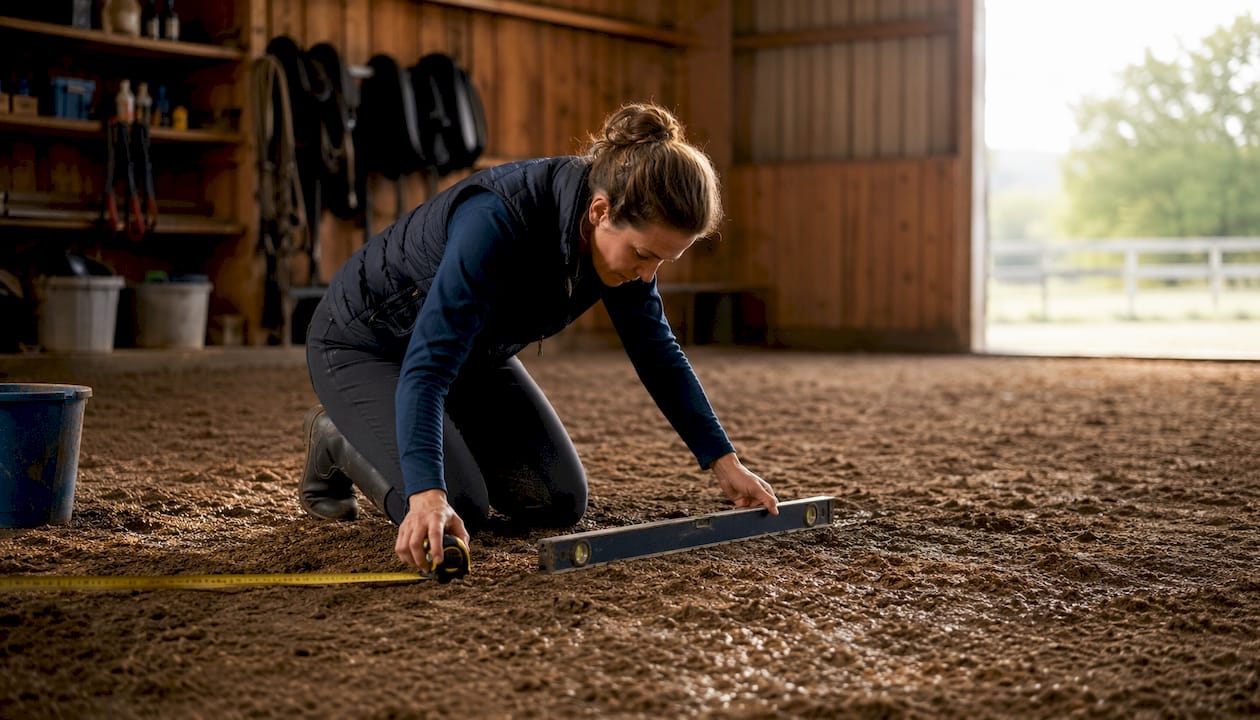
- Check footing depth using a ruler or depth probe at multiple points: the quarter line, centre line, three-quarter line, and any high-impact areas such as jump landings and lunging circles.
- Inspect drainage paths around and beneath the arena. Outdoor arenas in the UK are particularly vulnerable to waterlogging during autumn and winter; any blocked drainage channels must be cleared before levelling begins.
- Verify the base layer is intact and level. If the base has developed ruts or low spots, these must be addressed before surface levelling, as no amount of footing redistribution will compensate for a compromised foundation. Understanding why the base layer matters is fundamental to getting levelling right.
- Secure or remove perimeter fencing where possible to allow the levelling equipment to reach the edges cleanly.
Which tools do you need for effective arena levelling?
Choosing the right equipment is where many horse owners underestimate the task. Makeshift tools, such as a homemade drag or a chain-link harrow without tines, simply cannot address deep compaction or redistribute footing evenly across a full arena.
- ArenaMate® leveller: A purpose-built arena leveller featuring adjustable tines and a rear roller. The tines break up compacted material and blend footing layers, while the roller smooths and lightly firms the surface to a consistent texture. Models with a built-in adjustable side blade pull material back from kick boards automatically, removing the need for manual raking on every pass.
- Laser level: Used to measure and verify the gradient across the arena floor. In the UK, outdoor arenas typically require a fall of 1:100 to 1:60 to shed rainwater effectively. A laser level confirms whether the surface maintains this gradient after levelling or whether material has migrated and altered the slope.
- Excavator: Required for major site shaping, base correction, or initial arena construction. An excavator is not a routine levelling tool, but it is the correct piece of equipment when the base layer needs regrading or when significant volumes of material must be moved.
- Tractor or ATV-towed graders with adjustable tines: Versatile for regular maintenance. Tine depth must be calibrated carefully: too deep and the tines scrape into the base layer; too shallow and they fail to break up compaction below the surface crust.
- Rollers: Used after tining to smooth and lightly compact the surface. For sand or mixed footing, a heavier roller produces a firmer, more level finish suited to dressage and jumping disciplines.
- Hand rakes and shovels: Essential for corners and edges that mechanised equipment cannot reach cleanly.
Pro Tip: Before each levelling session, perform a depth check with a ruler at several points around the arena. Adjust tine depth so the equipment glides just above the stable base layer rather than into it. This single habit prevents the most common and costly form of arena damage.
| Equipment | Primary function | Suitable for |
|---|---|---|
| ArenaMate® leveller | Break compaction, blend layers, smooth surface | Routine maintenance |
| Laser level | Verify gradient and surface uniformity | Periodic assessment |
| Excavator | Major base shaping and regrading | Initial build or base repair |
| Tractor-towed grader | Regular dragging and redistribution | Weekly to monthly maintenance |
| Roller | Surface smoothing and light compaction | Post-levelling finishing |
| Hand rake / shovel | Edge and corner maintenance | Regular grooming sessions |
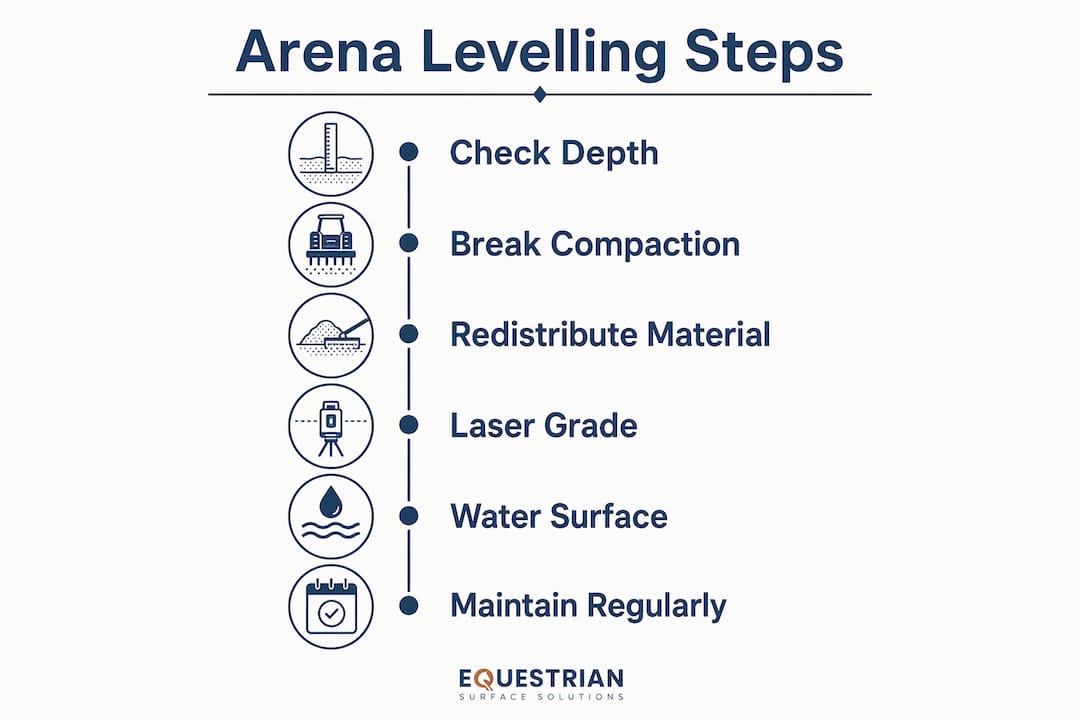
Step-by-step: how to level and dress a horse arena surface
A methodical approach to levelling produces far better results than a quick pass in one direction. Follow these steps for a consistent, safe finish.
- Assess and mark problem areas. Walk the arena before starting. Note visible tracks along the rail, compacted patches near jump landings, and any low spots where water pools. These areas need additional attention during levelling.
- Set tine depth correctly. Calibrate the ArenaMate® leveller or tractor-towed grader so tines penetrate the footing layer without reaching the base. A depth check with a ruler confirms the right setting.
- Begin with a perimeter pass. Make one or two passes close to the fence line, as close to the kick boards as the equipment allows. This loosens compacted material along the track where horses work most frequently.
- Work inward in overlapping passes. Turn down the centre line and make successive passes slightly overlapping the previous one. Vary the direction on alternate sessions to prevent directional grooves forming in the surface.
- Apply cut and fill where needed. In areas where footing has migrated to the edges, use the leveller’s side blade or a shovel to pull material back towards the centre before making a final smoothing pass.
- Manage moisture during levelling. If the surface is very dry, light watering before levelling helps the tines work more effectively and reduces dust. Avoid levelling a waterlogged surface, as wet footing compacts under equipment weight rather than loosening.
- Finish with roller passes. After tining, use the roller attachment to smooth the surface and produce a consistent texture. This is particularly beneficial for competition arenas where a firm, even surface is required.
- Verify with a laser level. Check the gradient at several points to confirm the surface still carries the correct fall for drainage. Adjust with additional passes if material redistribution has altered the slope.
Proper levelling breaks up compaction and blends footing layers. A surface that looks smooth after a single drag may still hide deep compaction beneath, where the footing has been pushed together rather than genuinely loosened. Structural integrity, not surface appearance, is the measure of a well-levelled arena.
Pro Tip: Vary your drag pattern at every session. Using the same route repeatedly creates compacted wheel tracks and leaves certain areas consistently under-worked. Changing direction and pattern each time distributes wear evenly and keeps the full arena surface in balance.
How often should you level and maintain your arena?
There is no universal schedule. The right frequency depends on how heavily the arena is used, the footing type, and the British climate’s seasonal demands. The principle is straightforward: drag slightly more often than it takes for wear patterns to develop.
- Daily or every other day for arenas in heavy commercial use, such as livery yards with multiple riders or competition venues.
- Two to three times per week for private arenas with regular daily use by one or two horses.
- Weekly for lightly used arenas, though a deeper drag monthly is still advisable to refresh footing and check base integrity.
- Water the surface before levelling in dry conditions. Moisture management is the single most important factor in preserving footing cohesion and reducing dust. Dry footing lacks stability; a correctly moistened surface holds its structure far better under hoof pressure.
- Remove manure and leaves after every session. Organic matter breaks down into fine particles that alter footing composition, increase dust, and can introduce bacteria into the surface layer.
- Rotate jump positions regularly, ideally weekly. Static jumps concentrate high-impact loading in one spot, creating deep holes and uneven compaction that regular levelling alone cannot fully correct.
- Hand-rake edges every fifth or sixth grooming session. Mechanised equipment consistently pushes footing outward; without manual edge work, trenching develops along the rail and drainage is compromised.
Pro Tip: Vary your lunging location each session. Repeated circles in the same spot create a bowl-shaped depression that mechanised levelling struggles to correct once it becomes established.
Expert insights on common levelling challenges
The most costly mistake in arena maintenance is dragging too deeply into the base layer. Operators should calibrate equipment to glide just above the stable base, not into it. Once the base is damaged, the repair typically involves excavation and reinstallation, a far greater expense than any maintenance programme.
A visually smooth surface can mask serious structural problems beneath. When footing is dragged repeatedly without depth checks, the tines gradually erode the base layer, creating an arena that looks acceptable but performs dangerously. The ‘pretty surface’ fallacy is one of the most common pitfalls in arena management.
Brett Raflowitz of Equestrian Services International describes arena care as equivalent to keeping a vehicle in top condition: daily maintenance reduces the effort required for annual overhauls and protects the long-term investment in the surface.
Key principles from equestrian surface specialists:
- Adapt maintenance to your footing type. Sand arenas, fibre blends, and rubber surfaces each respond differently to dragging and moisture. One-size-fits-all schedules accelerate surface degradation rather than preventing it.
- Perform depth checks throughout the arena, not just in the centre. High-impact areas near jump landings and stopping zones wear faster and need more frequent attention.
- Address common surface problems before they become structural. A rut along the track that reaches the base layer is a permanent problem; caught early, it is a ten-minute job with a shovel.
What does horse arena levelling cost in the UK?
Costs vary considerably depending on whether you are maintaining an existing surface or undertaking a full regrading project. For routine maintenance, the primary investment is in quality equipment. A professional-grade arena leveller suitable for tractor or ATV use represents a one-off capital cost, but it pays for itself quickly when set against the alternative of professional call-outs or premature surface replacement.
Professional regrading, which involves laser levelling, tilling, and resurfacing, is typically required annually for heavily used arenas. The cost depends on arena size, footing type, and the extent of base correction needed. For a standard 20m x 40m arena, surface top-up materials such as silica sand or fibre additives represent an additional periodic expense as material is lost through use and edge migration.
Investing in the right maintenance equipment from the outset, rather than relying on makeshift drags, reduces long-term costs substantially. Base repairs caused by over-dragging are among the most expensive remediation jobs in equestrian facility management.
How do UK seasons affect arena levelling and maintenance?
British weather places particular demands on outdoor arenas. Each season brings a different set of challenges that should shape your maintenance approach.
Autumn and winter bring the highest risk of waterlogging. Drainage must be checked and cleared before the wet season begins. Levelling a saturated surface compacts it further rather than loosening it, so timing sessions around drier spells is important. Fibre-blend surfaces tend to handle wet conditions better than pure sand, as the fibre component helps retain structure and resist waterlogging.
Spring often reveals the damage accumulated over winter: edge trenching, compacted tracks, and areas where frost has heaved the surface unevenly. A thorough deep drag and depth check at the start of spring, combined with edge raking and any necessary top-up material, resets the surface for the riding season ahead.
Summer brings the opposite problem: dry, dusty surfaces that compact quickly under hoof pressure. Regular watering before levelling sessions is particularly important during dry spells. Silica sand surfaces without adequate moisture management can become almost as hard as concrete in prolonged dry weather.
Adapting your levelling frequency and technique to the season, rather than following a fixed calendar, keeps the surface performing consistently year-round.
Key takeaways
Horse arena levelling is the foundation of safe, consistent riding surfaces: without it, compaction, trenching, and base damage are inevitable.
| Point | Details |
|---|---|
| Levelling prevents injury | Breaking up compaction and redistributing footing removes the uneven spots that cause slips, trips, and lameness. |
| Depth checks protect the base | Calibrate equipment to glide just above the base layer; damaging it requires expensive reinstallation. |
| Edge maintenance is critical | Hand-rake edges every fifth or sixth grooming session to prevent trenching and footing loss. |
| Frequency depends on use | Heavy commercial arenas may need daily levelling; lightly used private arenas can manage with weekly sessions. |
| Seasonal adaptation matters | Adjust levelling timing and technique to British weather conditions to avoid compacting wet surfaces or neglecting dry ones. |
FAQ
How do you level a horse arena?
Use a purpose-built arena leveller such as the ArenaMate® leveller, set tines to the correct depth just above the base layer, and work in overlapping passes from the perimeter inward. Vary the drag pattern each session and follow up with roller passes to smooth the surface.
How often should you drag an arena?
Drag slightly more often than it takes for visible wear patterns to develop. For heavily used arenas this can mean daily; for lightly used private arenas, two to three times per week is a reasonable starting point, with a deeper monthly drag to refresh footing and check base integrity.
How deep should horse arena footing be?
The goal is approximately two inches of soft, workable footing above the compacted base layer. Regular depth checks with a ruler at the quarter line, centre line, and high-impact areas confirm whether footing depth is consistent across the arena.
Does an arena need to be watered before levelling?
Yes, particularly in dry conditions. Moisture helps tines work more effectively through the footing layer and prevents dust. Avoid levelling a waterlogged surface, as wet footing compacts under equipment weight rather than loosening.
What are the signs that your arena needs levelling?
A visible track along the rail, hoof prints that have become so compacted they are hard to distinguish, footing banked up against the kick boards, or soft patches near jump landings all indicate the surface needs attention. If horses are working off the base layer in any area, levelling is overdue.
