
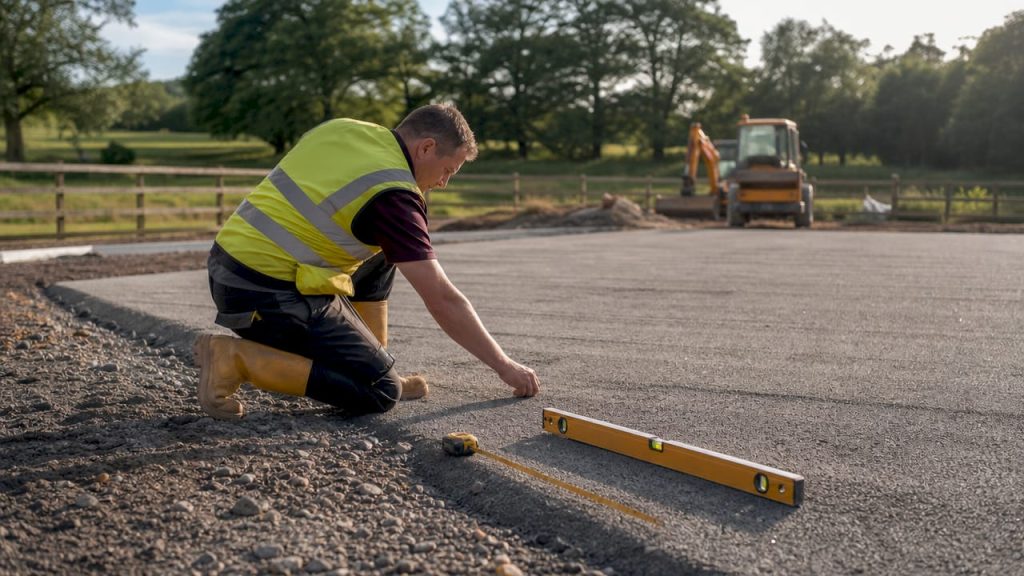
The arena base is the engineered foundation that directly determines how long a riding surface performs safely and consistently. Without a correctly constructed base, even the highest-quality silica sand or fibre footing will fail prematurely. This is why arena base affects surface longevity far more than the choice of top material alone. Equestrian professionals and horse owners who understand this relationship make better construction decisions, avoid costly repairs, and protect their horses from the risks of uneven or unstable footing. The base layer is not a background detail. It is the single most important factor in surface durability.
Why arena base affects surface longevity: the core mechanics
The arena base is the compacted structural layer that sits between the natural subgrade and the riding footing above. Its job is to distribute load, manage water, and provide a stable platform that does not shift or degrade under repeated hoof impact. When the base performs correctly, the footing above stays consistent in depth, texture, and drainage. When it fails, every problem you see at the surface traces back downward.
The base layer typically consists of compacted crushed stone or road base aggregate, laid over a prepared subgrade and separated by a geotextile membrane. This membrane is not optional. Skipping the geotextile fabric to save upfront costs is the primary cause of premature base failure requiring full reconstruction. The fabric prevents fine particles from the subgrade migrating upward into the stone layer, which would otherwise block drainage and destabilise the entire structure.
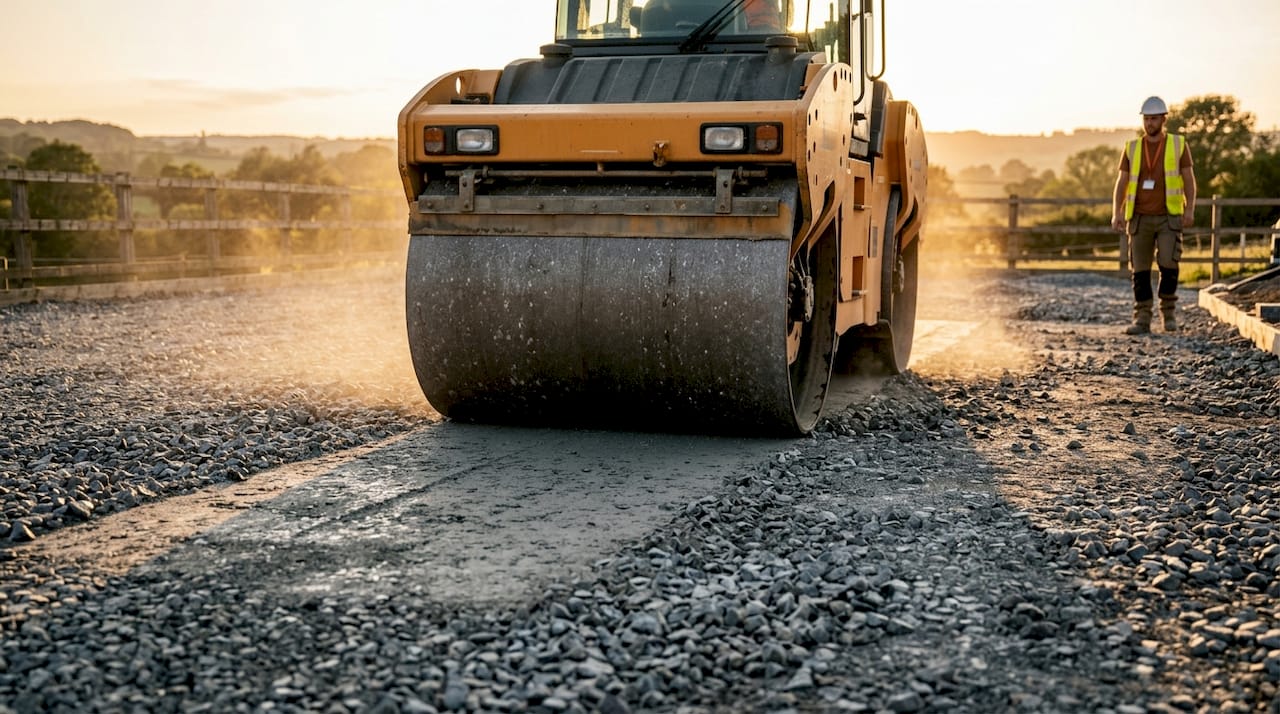
Drainage is the second critical function. A crown slope of 1–2% across the base surface channels water away from the arena rather than allowing it to pool beneath the footing. Drainage failures produce spongy, unstable surfaces that take days to dry after rain. That instability accelerates surface wear and creates uneven footing conditions that increase injury risk for horses.
What materials and construction techniques define a quality base?
A well-built arena base uses crushed stone or road base aggregate, compacted in lifts of 100–150mm at a time. Each lift must reach adequate density before the next is added. Rushing this process leaves voids that collapse under load, causing the surface above to sink unevenly.
The compaction method matters as much as the material. Over-compacting the stone sub-base creates a hard pan that prevents drainage and stops the footing from bonding correctly to the layer below. A single roller pass is the recommended approach for the final layer. The goal is a stable, porous base with sufficient drainage capacity, not a solid slab.
For clay-heavy subgrades with a plasticity index above 20, chemical stabilisation is necessary. Mixing lime or Portland cement at 4–6% by weight into the top 200–300mm of subgrade reduces plasticity and improves load-bearing capacity. Skipping this step on reactive clay soils causes base failure within the first five years.
| Base material | Key benefit | Limitation |
|---|---|---|
| Crushed stone aggregate | Excellent drainage and load distribution | Requires correct compaction technique |
| Road base (Class 6 equivalent) | Widely available, cost-effective | Must be tested for fines content |
| Lime-stabilised subgrade | Reduces clay plasticity and movement | Requires soil testing before application |
| Geotextile separation layer | Prevents fines migration, protects drainage | Cannot compensate for poor compaction |
Pro Tip: Always commission a subgrade soil analysis before specifying base materials. Soil quality varies significantly across a single site, and building on untested ground is the most common owner mistake in arena construction.
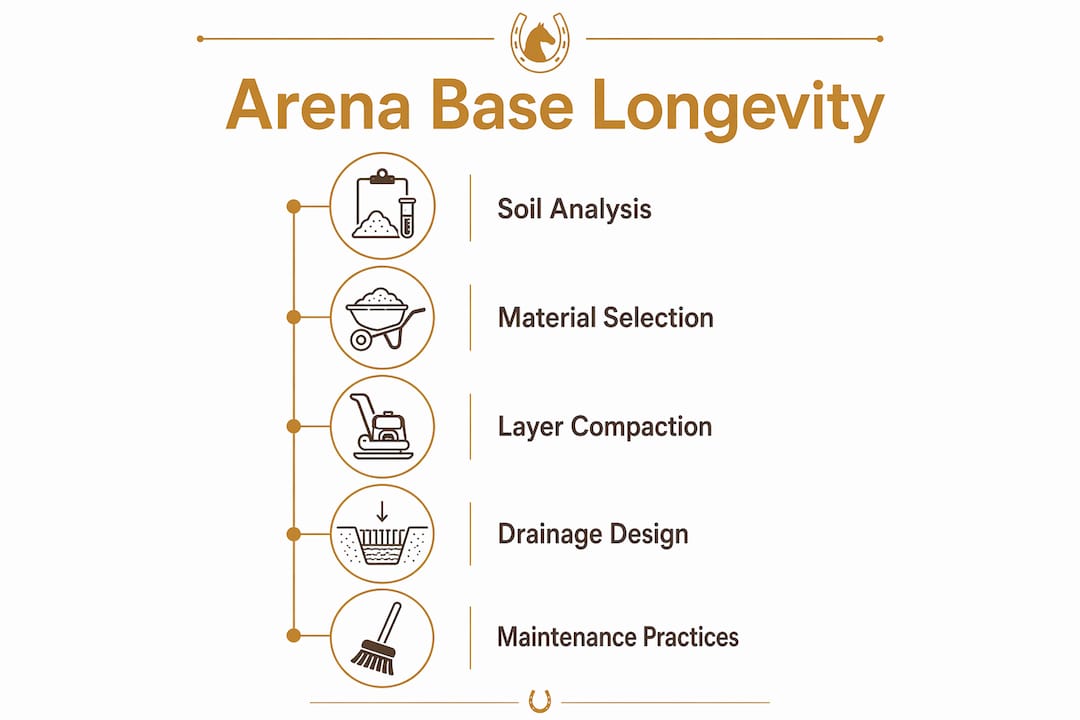
How does poor base construction cause surface failures?
Surface failure is consistently misdiagnosed as a top layer problem. Owners add more sand, top up with fibre, or re-level the footing, only to see the same issues return within months. The symptoms are real, but the cause sits below the surface.
Signs of base failure include persistent puddles that do not drain after rain, dark dirt patches appearing within the sand layer, and deep divots that cannot be smoothed out with regular harrowing. These symptoms indicate subgrade contamination or drainage failure, not surface wear. Recognising them early is the difference between a maintenance job and a full reconstruction.
The financial consequences are severe. Repairing a failed arena base costs significantly more than installing a correctly engineered base from the start. Repair costs can reach £15,000–£30,000, and that figure excludes the cost of replacing contaminated footing material on top. By contrast, the geotextile membrane that prevents the most common failure mode costs a fraction of that to install correctly at the outset.
Common warning signs equestrian professionals should recognise:
- Puddles that persist for more than 24 hours after rain, indicating drainage blockage at base level
- Sand or fibre footing that feels hard and compacted in patches, suggesting subgrade contamination below
- Visible rutting or sinking in high-traffic areas such as track lines and jump approaches
- Footing depth that appears to reduce over time despite no material being removed
- Dust in dry conditions combined with waterlogging after rain, pointing to inconsistent base drainage
The absence of a geotextile layer on a 60×120 metre arena saves approximately £4,000–£5,000 at build stage. The same arena typically requires £25,000–£40,000 in repairs within four years. That is not a saving. It is a deferred cost with interest.
What maintenance practices prolong base and surface lifespan?
Routine maintenance protects the base by preventing the surface above from degrading to a point where it transfers stress downward. The base layer itself is largely self-contained once correctly built, but poor surface management accelerates base deterioration.
- Grade and level the surface regularly. Deep ruts concentrate hoof impact in narrow zones, which eventually transfers load unevenly to the base below. Regular harrowing prevents ruts from forming and distributes wear across the full arena area.
- Monitor drainage after every significant rainfall. Water that pools on the surface for more than 24 hours signals a drainage issue at base or subgrade level. Address it before the next heavy use period.
- Top up footing material on schedule. Sand volume calculations should include a 15–20% compaction factor for initial settlement. Owners who do not plan for this underestimate how much material they need and allow the footing to thin out, exposing the base to direct hoof impact.
- Avoid overloading the arena. Repeated use by heavy machinery or vehicles outside of maintenance operations compacts the footing and can damage the base layer beneath.
- Inspect for early contamination signs. Check for dark patches, unusual firmness, or changes in drainage behaviour at least twice per year. Early intervention prevents minor base issues from escalating.
Pro Tip: Schedule a full drainage inspection each autumn before the wet season begins. Catching a blocked outlet or a developing soft spot at this stage costs a fraction of what it takes to address the same problem after a winter of heavy use. Equestriansurfacesolutions recommends pairing this with a surface condition review to assess footing depth and material quality at the same time.
How do soil conditions and climate affect arena base design?
The subgrade beneath your arena is not a neutral starting point. Its composition directly determines what base design will work and what will fail. Clay-heavy soils with high plasticity expand when wet and contract when dry, creating a moving platform beneath the base that causes cracking, sinking, and uneven settlement over time.
In the UK, many sites sit on clay or mixed clay-loam subgrades. These require either chemical stabilisation or geogrid reinforcement before the stone base is laid. Geogrid panels interlock with the aggregate above to spread load across a wider area, reducing point pressure on weak subgrades. The choice between lime stabilisation and geogrid depends on the plasticity index of the soil and the expected traffic load on the arena.
| Condition | Recommended adaptation |
|---|---|
| High-plasticity clay subgrade | Lime or Portland cement stabilisation at 4–6% by weight |
| Frost-prone northern sites | Increase base depth to reduce freeze-thaw movement |
| High-rainfall western regions | Steepen crown slope and install perimeter drainage channels |
| Sandy or free-draining subgrades | Geotextile separation layer remains critical to prevent fines loss |
| Mixed or unknown subgrade | Commission soil test before specifying any base design |
Frost is a particular concern for northern UK sites. Freeze-thaw cycles lift and shift the base layer, creating surface undulation that worsens each winter. Increasing base depth reduces the effect of ground frost on the structural layer. Pairing this with a well-designed arena drainage system prevents water from saturating the base before a freeze, which is the primary mechanism of frost damage.
Arid or free-draining sites present a different challenge. Sandy subgrades lose fines through the base over time if no geotextile is present, gradually undermining the stone layer from below. The geotextile is as critical on free-draining sites as it is on clay, though for opposite reasons.
Key takeaways
The arena base is the single most important factor in surface longevity, and no amount of quality footing material compensates for a poorly constructed or unmaintained base beneath it.
| Point | Details |
|---|---|
| Base construction determines longevity | A correctly engineered base with geotextile and proper compaction prevents the majority of surface failures. |
| Geotextile is non-negotiable | Skipping the separation membrane saves little upfront but causes failures costing many times more within four years. |
| Drainage design is structural | A 1–2% crown slope and perimeter drainage channels prevent water pooling that destabilises the base layer. |
| Soil testing prevents failure | Subgrade analysis before construction identifies clay plasticity or drainage issues that require specific base adaptations. |
| Maintenance protects the base | Regular grading, drainage monitoring, and timely footing top-ups prevent surface wear from transferring stress to the base. |
The base is where I start every conversation
When horse owners contact me about surface problems, the first question I ask is about the base. Not the sand grade, not the fibre blend, not the maintenance schedule. The base. In my experience, the majority of persistent surface problems trace directly to a base that was either under-specified, built without a geotextile, or laid on untested subgrade.
The most common misconception I encounter is that surface failure is a surface problem. Owners spend money on fresh footing, only to watch it degrade again within a season. The new material sits on the same broken foundation and produces the same results. Until the base is addressed, the footing above cannot perform correctly.
The false economy that frustrates me most is the decision to skip geotextile fabric. The saving is real but small. The cost of the repair it eventually necessitates is large and disruptive. I have spoken with owners who rebuilt their entire arena base within five years of the original build, purely because this one layer was omitted. That is an avoidable outcome.
My recommendation is straightforward. Invest in a soil test before you specify anything. Build the base with a geotextile, correct compaction, and a proper drainage slope. Then choose your footing material. That sequence produces arenas that last. Reversing it produces arenas that require constant intervention and eventually full reconstruction.
— Hooman
How Equestriansurfacesolutions supports durable arena construction
Building a long-lasting arena starts with the right materials at every layer, and Equestriansurfacesolutions supplies the full range needed for both new builds and refurbishment projects across the UK.

From woven and non-woven membranes that provide the critical separation layer between subgrade and base, to premium silica sand and fibre blends designed to perform on correctly constructed bases, every product is selected for durability and surface compatibility. Equestriansurfacesolutions also offers self-build kits and material supply for owners managing their own construction projects, with expert guidance on material selection for your specific discipline, soil type, and climate. If you are planning a new arena or addressing an existing surface problem, the arena surface advice hub is a practical starting point.
FAQ
What is the most common cause of arena base failure?
Skipping the geotextile separation layer is the most common cause. Without it, subgrade fines migrate into the stone base, blocking drainage and destabilising the structure within a few years.
How does the arena base affect surface drainage?
The base layer controls whether water moves through and away from the arena or pools beneath the footing. A correctly sloped base with a 1–2% crown directs water to perimeter drains, preventing the waterlogging that makes surfaces spongy and unusable.
Why does arena footing depth reduce over time?
Settlement is the primary reason. Sand volume calculations must include a 15–20% compaction factor to account for initial settlement after installation. Owners who do not plan for this find their footing appears insufficient shortly after build.
Can I fix arena surface problems without rebuilding the base?
Surface-level repairs only work if the base is structurally sound. If base failure symptoms such as persistent puddles, dark contamination patches, or deep divots are present, addressing only the footing above will not resolve the underlying problem.
How deep should an arena base be in the UK?
Base depth depends on subgrade conditions and climate. Clay subgrades and frost-prone northern sites require greater depth to manage movement and freeze-thaw cycles. A soil test is the only reliable way to specify the correct depth for your site.
