

Arena footing, the industry term for what riders commonly call an equestrian surface, is the single most influential factor in both horse welfare and riding performance. Choosing the right types of equestrian arena surfaces means understanding how each material behaves under load, how it drains, and how it ages. The four principal categories are silica sand, sand-fibre mixes, rubber-based blends, and waxed or hybrid surfaces. Each suits different disciplines, budgets, and maintenance commitments. Get this decision right and you protect your horse’s joints, your training programme, and your long-term investment.
1. Silica sand: the foundational arena surface
Silica sand is the default UK arena surface, chosen for its angular grain structure that locks together under load and releases cleanly under hoof. That interlocking quality gives consistent grip without the surface becoming compacted or slippery. It is also the most budget-friendly starting point for any new arena build.
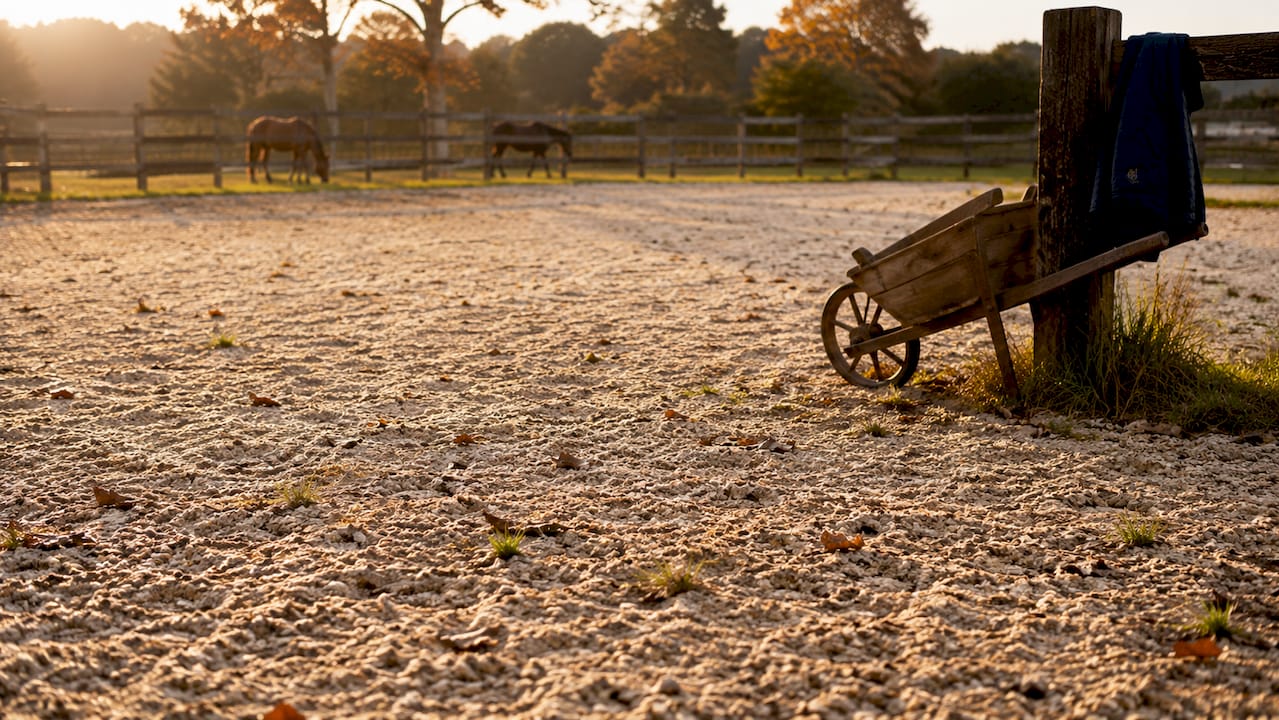
The standard specification calls for a depth of 100–150mm laid over a free-draining base of crushed rock and stone dust. That depth matters because too little sand creates a hard, unforgiving ride, while too much causes the horse to sink and strain tendons. Silica sand drains well when the base is correctly constructed, making it a practical choice for outdoor schooling arenas in the UK’s wet climate.
Key characteristics of silica sand surfaces:
- Angular grains provide natural grip and resist compaction
- Affordable material cost compared to fibre or rubber blends
- Requires regular harrowing to maintain level depth
- Can become dusty in dry conditions without moisture management
- Best suited to schooling arenas and budget-conscious builds
Pro Tip: Choose washed, graded silica sand with a consistent particle size. Unwashed sand contains fine clay particles that bind and harden, creating an uneven surface that is difficult to correct.
2. Sand-fibre mix: stability and performance combined
Sand-fibre surfaces blend synthetic fibres into silica sand at a ratio of 5–10% by volume, producing a surface that holds together under lateral movement and recovers its shape after each stride. That recovery is what makes fibre mixes the preferred choice for dressage and show jumping at club and professional level.
The fibres used are typically polyester, polypropylene, or nylon blends, each offering slightly different tensile strength and longevity. Polypropylene fibres resist UV degradation well, making them particularly suited to outdoor arenas with high sun exposure. The fibre content also reduces dust significantly compared to plain sand, which benefits both horse respiratory health and rider comfort.
Performance advantages of sand-fibre surfaces:
- Greater surface stability under collected and lateral work
- Reduced dust and improved air quality in enclosed arenas
- Lower compaction rate, meaning less frequent harrowing
- Better cushioning for horses in intensive training programmes
- Higher initial material cost than plain sand, offset by reduced maintenance frequency
Pro Tip: When topping up a sand-fibre arena, always match the original fibre specification. Mixing different fibre types changes the surface behaviour and can create inconsistent grip across the school.
3. Rubber-based surfaces: cushioning and longevity
Rubber crumb surfaces, typically sourced from recycled SBR (styrene-butadiene rubber) tyre crumb, add significant shock absorption to an arena surface. The standard specification uses 30–40% rubber crumb blended with clean silica sand at a depth of 75–100mm on a free-draining base. That cushioning effect directly reduces concussion on fetlocks, knees, and hocks, making rubber blends particularly valuable for horses in rehabilitation or high-impact disciplines.
Rubber surfaces do carry one significant risk. Rubber migration occurs when the base is not properly graded and crowned, causing rubber particles to pool in low spots and create uneven footing. A correctly crowned base with a 1–2% fall to the edges prevents this. Without it, you will find deep pockets of rubber at one end of the school and bare sand at the other.
| Feature | Benefit | Consideration |
|---|---|---|
| 30–40% rubber crumb content | High shock absorption | Requires crowned base to prevent migration |
| Recycled SBR material | Cost-effective sourcing | Quality varies by supplier |
| 75–100mm depth | Consistent cushioning | Shallower depth reduces performance |
| Good drainage properties | Suitable for outdoor arenas | Base construction is critical |
Rubber blends suit jumping arenas, gaited horse facilities, and rehabilitation paddocks where reduced concussion is the priority.
4. Waxed and hybrid surfaces: premium performance
Waxed surfaces take a sand-fibre mix and bind the particles together with a wax coating, typically a plant-based or mineral wax applied during manufacture. Wax binds fibres and sand grains, suppresses dust almost entirely, and stabilises the surface against temperature and moisture changes. The result is a surface that performs consistently whether the arena is cold and damp in january or warm and dry in august.
These surfaces are the standard at elite competition venues because they require less harrowing and maintain their depth profile more reliably than unwaxed alternatives. The FEI specifies that high-quality footing balances impact firmness, cushioning, responsiveness, grip, and uniformity. Waxed surfaces meet all five criteria more consistently than any other material category.
Key benefits of waxed and hybrid surfaces:
- Near-total dust suppression, critical for indoor arenas
- Weather-stable performance across seasons
- Consistent grip and cushioning under competition conditions
- Longer intervals between harrowing compared to unwaxed surfaces
- Higher installation cost, justified by reduced maintenance spend over the surface lifecycle
For indoor arenas where dust control is non-negotiable, a waxed surface is the most reliable long-term choice. You can read more about specifying these materials in the competition arena guide from Equestrian Surface Solutions.
5. Factors affecting arena surface choice and maintenance
Surface material is only one part of the decision. Proper arena construction requires a multi-layer base of crushed rock and stone dust beneath the riding surface. Without that foundation, even the most expensive surface material will fail within a few seasons.
Maintenance is where most arenas fall short. Harrowing and moisture control are more critical than the choice of surface material for safe and consistent footing. A neglected waxed surface will degrade below the performance of a well-maintained plain sand arena. The key maintenance factors to manage are:
- Depth consistency — check surface depth at multiple points monthly and top up where needed
- Moisture management — water the surface before use in dry conditions to prevent dust and hardening
- Regular harrowing — frequency depends on usage, but most arenas need harrowing at least twice weekly
- Drainage inspection — clear drainage channels seasonally to prevent waterlogging at the base
- Surface testing — periodic firmness testing identifies problem areas before they cause injury
Inconsistent footing forces horses to alter their stride, causing abnormal joint loading and increased risk of lameness. That connection between surface quality and equine soundness is why surface testing and maintenance scheduling are not optional extras. They are core to responsible horse ownership. The arena maintenance guide from Equestrian Surface Solutions covers inspection schedules and top-up protocols in practical detail.
Pro Tip: Walk your arena barefoot once a month. You will feel depth inconsistencies, hard spots, and wet patches far more accurately than any visual inspection.
Key takeaways
The right arena surface protects horse health, suits your discipline, and holds its performance only when maintained consistently and built on a sound base.
| Point | Details |
|---|---|
| Silica sand is the baseline | Angular grains provide grip and drainage at the lowest material cost. |
| Fibre mixes improve stability | A 5–10% fibre content reduces compaction and suits dressage and jumping. |
| Rubber blends reduce concussion | 30–40% rubber crumb at 75–100mm depth requires a crowned base to prevent migration. |
| Waxed surfaces lead on consistency | Wax-bound surfaces suppress dust and maintain grip across seasons, standard for competition venues. |
| Maintenance outweighs material choice | Regular harrowing and moisture control determine surface safety more than the material itself. |
What I’ve learned about surfaces that most owners find out too late
Arena surfaces are not a one-time purchase. They are a dynamic system, and treating them as “set and forget” is the most expensive mistake I see owners make. A beautifully installed waxed surface left without harrowing for six months will develop hard, compacted channels along the track and deep, loose pockets in the centre. At that point, you are not just dealing with poor rideability. You are dealing with a genuine injury risk.
The misconception I encounter most often is that a more expensive surface means less work. The opposite is closer to the truth. Premium surfaces perform better when maintained, but they do not maintain themselves. What changes with a higher-specification surface is the margin for error. A waxed surface tolerates a missed harrowing session better than plain sand. But it still needs that session.
The other thing owners consistently underestimate is the base. I have seen good-quality silica sand laid on a poorly graded base turn into a waterlogged, uneven mess within two winters. The surface material gets the blame, but the base was always the problem. Surface management as preventative medicine is the framing that finally makes sense to most owners. You would not skip your horse’s farriery. Do not skip your arena’s maintenance either.
— Stacey
How Equestrian Surface Solutions supports your arena build
Whether you are building a new schooling arena on a tight budget or refurbishing a competition surface to FEI standards, Equestrian Surface Solutions supplies the materials and guidance to get it right.
From premium silica sand and fibre blends to rubber chipping surfaces and drainage membranes, the full product range covers every surface type discussed in this article. Self-build kits make professional-specification surfaces accessible without the full cost of a managed installation. The team at Equestrian Surface Solutions offers bespoke advice matched to your discipline, arena size, and budget. Request a quote directly through the equestrian surfaces quote page to get a clear, no-obligation cost for your project.
FAQ
What is the best surface for a dressage arena?
A sand-fibre mix with 5–10% synthetic fibre content is the preferred surface for dressage, providing the lateral stability and cushioning that collected work demands. Waxed sand-fibre surfaces offer the highest consistency for competition-level dressage.
How deep should an equestrian arena surface be?
Silica sand surfaces require 100–150mm depth over a free-draining base. Rubber-sand blends perform best at 75–100mm. Depth consistency across the whole arena is as important as the total depth.
Why do arena surfaces cause horse injuries?
Inconsistent footing forces horses to alter their stride, creating abnormal joint loading that increases the risk of lameness. Uneven depth, poor drainage, and neglected maintenance are the primary causes.
What is surface testing for equestrian arenas?
Surface testing measures the firmness, cushioning, and uniformity of arena footing at multiple points across the school. It identifies hard spots, soft pockets, and drainage failures before they cause injury.
Are waxed surfaces worth the extra cost?
Waxed surfaces suppress dust, stabilise performance across seasons, and require less frequent harrowing than unwaxed alternatives. For indoor arenas or competition venues where consistency is critical, the higher installation cost is offset by lower maintenance spend over the surface lifecycle.
