

An arena surface for dressage horses is a specialised footing designed to provide stable yet cushioned support for the precise movements and lateral work that define the discipline. Unlike surfaces built for jumping or Western riding, dressage footing is softer and must allow controlled pivoting without locking the hoof. The right surface protects tendons and joints, supports collection and extension, and gives you the consistency needed to train with confidence. Get it wrong and you risk uneven wear, injury, and a horse that compensates in its movement rather than performing freely.
What materials best suit arena footing for dressage?
Sand is the foundation of most dressage arena surfaces, but not all sand performs equally. Sub-angular grain shape is the standard for dressage: these grains lock together under slight compression, providing grip without the rigidity of sharp angular sand or the instability of fully rounded grains. Sharp sand compacts too hard and jars joints. Rounded sand shifts underfoot and causes sliding. Sub-angular silica sand sits precisely between those two failure modes.
Sand alone, however, rarely meets the full demands of dressage. Synthetic or natural fibres bind sand particles together, reduce dust, and add cushioning without sacrificing stability. Fibre blends also retain moisture more effectively, which reduces how often you need to water the surface. For dressage specifically, this moisture retention matters because a dry surface becomes loose and unpredictable, while an over-watered one turns heavy and tiring.
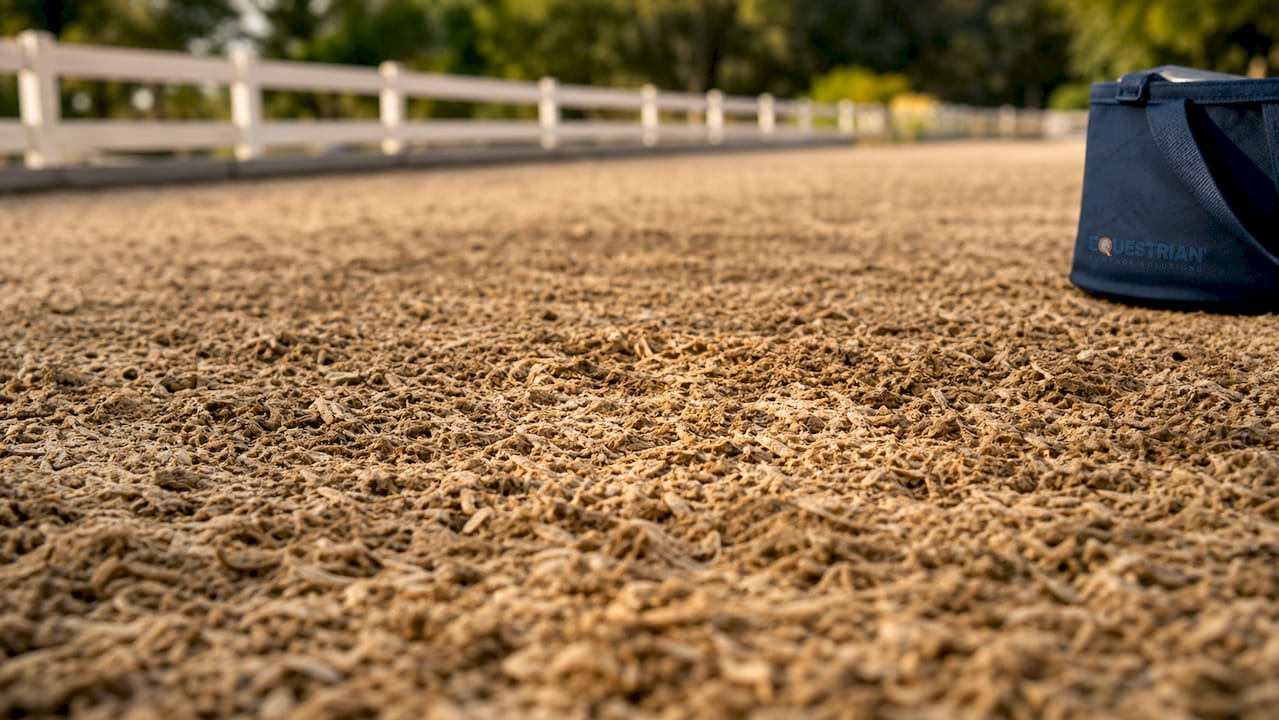
Other additives include rubber chippings and wood products. Rubber adds rebound and is particularly useful for all-weather arena footing where freeze-thaw cycles are a concern. Wood-based products can work in lower-traffic settings but break down faster than synthetic alternatives and require more frequent top-ups.
| Material category | Traction | Cushioning | Maintenance demand | Best use |
|---|---|---|---|---|
| Sub-angular silica sand | High | Moderate | Moderate | Dressage base layer |
| Sand and fibre blend | High | Good | Low to moderate | Dressage primary surface |
| Sand and rubber mix | Moderate | High | Low | All-weather, lateral work |
| Wood-based products | Variable | Moderate | High | Low-traffic schooling |
- Sub-angular silica sand provides the grip-to-give ratio dressage demands.
- Fibre additives reduce dust and improve moisture retention.
- Rubber chippings add rebound and resist freezing conditions.
- Wood products suit occasional use but degrade faster than synthetic options.
Pro Tip: Ask your supplier for a sieve analysis of any sand before purchasing. The grain size distribution tells you far more about surface performance than a visual inspection alone.
How does base construction and drainage affect surface quality?
The sub-base is the most important factor in long-term arena performance, and it receives far less attention than the top layer. A compacted stone sub-base prevents surface shifting and punch-through failures, where the top layer sinks unevenly under repeated loading. No amount of premium sand or fibre will compensate for a base that moves.
Between the sub-base and the riding surface sits the arena membrane. This layer separates the stone from the sand, preventing contamination from below and maintaining the integrity of the footing over time. Skipping the membrane is a false economy: once stone migrates into the sand layer, the surface becomes inconsistent and potentially dangerous.
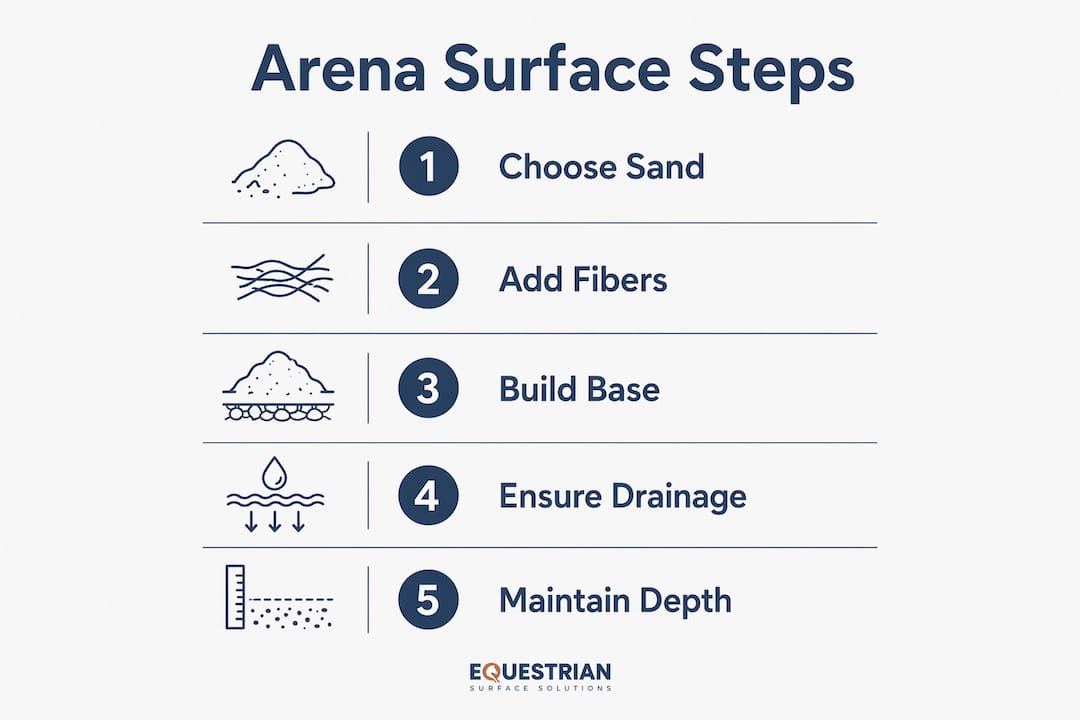
Drainage design is equally non-negotiable. Outdoor arenas require a 1%–2% slope or crown to shed water rapidly to the edges. A flat arena holds water, which softens the base and creates boggy failure zones. These zones cause uneven footing depth, unpredictable grip, and accelerated surface degradation.
| Design parameter | Recommended standard | Risk if ignored |
|---|---|---|
| Sub-base compaction | Firm, stable stone layer | Surface shifting, punch-through |
| Membrane layer | Woven or non-woven geotextile | Stone contamination of sand |
| Drainage slope | 1%–2% crown or cross-fall | Boggy zones, base softening |
| Surface depth | 5–10 cm of riding surface | Concussion or hoof sinking |
Pro Tip: Before laying any surface material, test your sub-base by walking it in wet conditions. If you sink more than a centimetre, the base needs further compaction before you proceed.
What is the ideal footing depth and maintenance routine?
Optimal footing depth for dressage sits between 5 and 10 cm. Below 5 cm, the surface provides insufficient cushioning and increases concussion through the lower limbs. Above 10 cm, the footing becomes too deep, placing excessive strain on tendons and ligaments as the horse works through lateral movements and transitions. Depth consistency across the entire arena matters as much as the average depth. A patch that is 4 cm deep beside one that is 12 cm deep creates unpredictable loading with every stride.
Regular maintenance is what keeps footing depth consistent and surface performance reliable. The frequency depends on usage, climate, and surface type, but most working arenas require attention several times per week.
A practical maintenance routine looks like this:
- Drag the surface after every session or at minimum daily to redistribute footing and prevent compaction tracks.
- Check moisture levels before each use. The surface should hold a hoofprint without crumbling or sticking.
- Water as needed to maintain the correct moisture level. Sand and fibre blends need less frequent watering than plain sand.
- Inspect depth weekly using a depth gauge or ruler at multiple points across the arena, including corners and the track.
- Top up material when depth falls below 5 cm in any area. Waiting until the whole surface is depleted increases the risk of injury.
- Assess the base monthly for signs of softening, particularly after heavy rainfall.
Pro Tip: Corners and the track along the long sides wear fastest in a dressage arena. Check these areas first and top them up before the centre, which typically retains depth longer.
What common problems arise and how should you address them?
Surface problems in dressage arenas almost always trace back to either poor initial design or inconsistent maintenance. Identifying the cause early prevents minor issues from becoming expensive failures.
A surface that looks fine at a walk can be dangerous at trot or canter. Uneven depth, hidden base softening, and compacted tracks all become apparent only when the horse is working at pace. Inspect your arena at speed, not just on foot.
Common problems and their causes include:
- Uneven footing depth: caused by insufficient dragging or high-traffic patterns. Fix by redistributing material and increasing drag frequency.
- Base softening: caused by inadequate drainage or a poorly compacted sub-base. Requires drainage inspection and, in severe cases, base remediation.
- Surface compaction: caused by repeated use without dragging. The surface loses cushioning and becomes hard underfoot. Regular dragging resolves early-stage compaction.
- Dust: caused by low moisture content, often in summer or in indoor arenas with poor ventilation. Watering and fibre additives both reduce dust significantly.
- Pooling water: caused by insufficient slope or blocked drainage channels. Inspect the crown and clear any drainage outlets.
Signs that require urgent attention include visible water pooling after rain, a surface that feels hard and unyielding at trot, hoofprints that sink deeper than 5 cm, and any area where the base feels soft or spongy underfoot. For arena surface failures that involve base movement or significant drainage failure, professional assessment is the right call before further use.
Key takeaways
The best arena surface for dressage horses combines sub-angular silica sand, fibre or rubber additives, a compacted stone sub-base, a geotextile membrane, and a 1%–2% drainage slope, maintained at a consistent depth of 5–10 cm.
| Point | Details |
|---|---|
| Sand grain shape matters | Sub-angular silica sand provides the grip-to-give balance dressage demands. |
| Fibre additives improve performance | Fibres bind sand, retain moisture, and reduce dust in dressage arenas. |
| Base and drainage are foundational | A compacted sub-base and 1%–2% drainage slope prevent the most costly failures. |
| Footing depth is safety-critical | Maintain 5–10 cm consistently; shallower increases concussion, deeper strains tendons. |
| Maintenance frequency protects investment | Regular dragging, moisture checks, and depth monitoring preserve surface performance. |
Why I think most riders underestimate the base
After working with dressage riders and trainers across the UK, the single most common regret I hear is not about the top surface. It is about the base. Riders invest in premium sand and fibre blends, then discover six months later that the sub-base was never properly compacted. The surface sinks unevenly, the membrane gets contaminated, and the whole installation needs remediation. That is an expensive lesson.
The uncomfortable truth is that spending more on base preparation and drainage than on the top layer is almost always the right decision. A modest sand and fibre blend on a well-built base will outperform a premium surface on a poor one every single time. The base is invisible once the arena is finished, which is exactly why it gets underestimated.
I also think the industry undersells the importance of matching surface characteristics to the specific demands of dressage. Dressage requires softer, stable footing that supports lateral work. A surface that suits a jumping arena will not serve a dressage horse well, and vice versa. Getting that specification right from the start, rather than retrofitting it later, saves both money and horse welfare concerns. Work with a supplier who understands discipline-specific requirements, not just general equestrian surfaces.
— Stacey
How Equestrian Surface Solutions supports your dressage arena
Equestrian Surface Solutions supplies specialist materials for dressage arena construction and refurbishment throughout the UK, from premium silica sand and fibre blends to drainage membranes and rubber additives. Whether you are building from scratch or topping up an existing surface, the right material specification makes a measurable difference to footing performance and horse welfare.
The team at Equestrian Surface Solutions offers tailored advice on surface composition, depth, and maintenance schedules based on your discipline, usage level, and climate. You can also request a full arena surface quote to plan your project with accurate material costs from the outset. Getting professional input early avoids the costly mistakes that come from specifying the wrong materials or skipping critical construction layers.
FAQ
What is the best arena surface for dressage horses?
A blend of sub-angular silica sand and synthetic fibres is the most widely recommended footing for dressage. This combination provides the grip, cushioning, and moisture retention that lateral work and collected movements demand.
How deep should dressage arena footing be?
Footing depth should sit between 5 and 10 cm. Shallower than 5 cm increases concussion; deeper than 10 cm places excessive strain on tendons and ligaments.
How often should a dressage arena be maintained?
Maintenance frequency depends on usage and climate, but most working arenas require dragging and moisture checks several times per week. High-use arenas may need daily attention.
Does drainage really affect arena surface performance?
Yes. A 1%–2% drainage slope is the standard for outdoor arenas. Without it, standing water softens the base and creates boggy zones that make footing unpredictable and unsafe.
Can the same surface suit dressage and rehabilitation work?
A well-specified sand and fibre surface works for both dressage training and rehabilitation, as the cushioning and stability it provides reduce concussion and support controlled movement. Depth management becomes especially important for rehab horses, where footing consistency directly affects recovery.
